

In early September 2026, a small part of the remains of the Muscovite prince Dmitry Donskoy was sent to the war in Ukraine. According to the Russian Orthodox Church, a reliquary presented to the Cathedral of the Resurrection of Christ in Kubinka outside Moscow, the central church of the Russian armed forces, contained a fragment of the medieval prince’s right hand. This was no arbitrary part of his body. Metropolitan Kirill of Stavropol, head of the Moscow Patriarchate’s department for co-operation with the armed forces, explained its significance: ‘In this hand he held the sword when he led the army on the Kulikovo Field and in other battles.’ At the Battle of Kulikovo in 1380, Donskoy had defeated the army of Mamai of the Mongol Golden Horde.
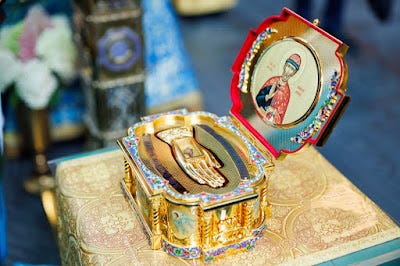
The relic’s destination was the front. And the Church itself made the meaning of the journey explicit. Donskoy was not merely to remind today’s soldiers of a distant victory. The holy prince himself was to stand invisibly alongside them. The Moscow Patriarchate’s department for co-operation with the armed forces declared: ‘The holy commander is going to where the fate of the Fatherland is being decided today, so that he may invisibly take his place in the same battle ranks as our defenders.’
More than six centuries had thus been drawn together. Kulikovo in 1380 and Ukraine in 2026 had become parts of the same story. On 8 September, the Moscow Patriarchate’s department for co-operation with the armed forces announced that the reliquary was on its way to the front.
Here, the historical continuity does not need to be inferred. The Church formulates it itself. Donskoy is not merely to inspire today’s soldiers through the memory of Kulikovo. He is said to take his place invisibly in the same battle ranks as them.
But what, exactly, is the history that accompanies this small piece of bone to the front? The answer extends far beyond the story of a medieval battle.
Kulikovo and the Gathering of Rus
Dmitry Donskoy was Grand Prince of Moscow and Vladimir when, in 1380, his forces defeated the army of Mamai of the Mongol Golden Horde at Kulikovo. During his reign, Moscow had also acquired its first stone kremlin, a fortified citadel that formed the city’s political and military centre. The white limestone walls, built in the 1360s, became a tangible expression of Moscow’s growing importance as a political and military centre. In later Russian historiography and historical memory, the Battle of Kulikovo came to be regarded as a decisive stage in the transition from fragmented Rus principalities and foreign overlordship to Moscow as the centre of an independent Russian realm.
The historical reality was less straightforward. The Battle of Kulikovo did not bring the Horde’s overlordship to an end. As early as 1382, the Mongols captured and burned Moscow, and the payment of tribute continued. But this does not make Kulikovo’s later significance incomprehensible. A historical battle can come to represent a process that lasted far longer than the battle itself.
The significance of Donskoy and the Battle of Kulikovo in Russian historiography today lies not only in Donskoy’s defeat of an external enemy. The battle can be placed within a much larger history: the rise of Moscow as the centre for the gathering of the Rus lands.
That narrative was already present in Vladimir Putin’s thinking before the full-scale invasion of Ukraine. In his 2021 essay on the historical unity of Russians and Ukrainians, he described Russians, Ukrainians and Belarusians as heirs to a common Rus and repeatedly returned to the way its territories had been divided over the course of history, fallen under different powers and been gathered together again. Ukraine was presented not simply as a neighbouring state with which Russia had historical ties, but as part of a shared historical and spiritual space.
Donskoy therefore need not be turned into a direct model for the 2022 invasion in order to fit into this view of history. He already belongs to its historical grammar. A fragmented Rus gathers around Moscow; foreign overlordship is challenged; political agency is restored.
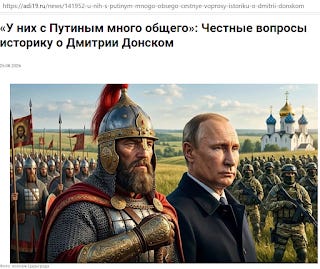
On 25 August, Tsargrad republished an interview with the historian Viktor Shokhin, accompanied by an AI-generated image showing Dmitry Donskoy and Vladimir Putin side by side. The formulation is unusually explicit: ‘Six hundred and fifty years ago, Dmitry Donskoy did the same thing that Putin is doing today – he united the country and the people in order to free the state from subjugation to external forces.’
The comparison, then, is not primarily between two individuals. It concerns their narrative positions. Donskoy and Putin are cast as leaders in the same recurring historical situation: the country must be brought together because external forces threaten its independence.
A Western Proxy Army in 1380
But if Putin can assume Donskoy’s position, the other side of the story must also be given a modern counterpart. On 24 August, the Russian television channel Rossiya 1 did precisely that. Mamai was portrayed as the leader of a Western ‘proxy army’. According to the report, Catholic Lithuania was pressing in from the north-west and the Genoese from the south. Genoese merchants and the Pope were said to have placed Mamai at the head of this proxy army, after which he advanced eastwards, ‘armed by the West’.
At first, the formulation sounds almost absurd. The concept of proxy war belongs to the international politics of our own time, not to the fourteenth century. Six and a half centuries later, a power structure that arose out of a Mongol conquest from the east is recast as an instrument of an attack from the west.
Mamai, who was not a Chinggisid, could not himself lay claim to the title of khan and instead exercised power through Chinggisid khans whom he installed and supported. This lends a particular irony to the modern description of Mamai’s forces as a ‘Western proxy army’. Mamai was hardly himself a proxy for the West. Rather, it was he who exercised power through others.
When the Aggressor Becomes the Defender
The concept of proxy is interesting not only because it is anachronistic when applied to the Battle of Kulikovo. It has also become one of the key terms in the narrative of the ongoing war. That Ukraine receives extensive military and economic support from the West is a fact. But it is a considerable step from there to the claim that Ukraine is therefore waging a Western proxy war against Russia. The latter is not merely a description of where the weapons come from. It changes who is cast as the true actor in the war.
If the war is described as Russia’s war against Ukraine, Ukraine is a political subject: a state attacked by another state and defending itself with foreign support. If the same war is described as a Western proxy war against Russia, the roles change. Ukraine becomes an instrument. The West becomes the true aggressor. And Russia can once again assume the role repeatedly offered by its historical war narratives: that of the defending power subjected to an attack from outside.
After more than four years of war, this shift in roles has acquired additional significance. If the war is primarily Russia’s war against Ukraine, the Russian leadership has to explain why the invasion of a considerably smaller neighbouring state did not produce the rapid political and military success that the original operation appears to have anticipated. If, on the other hand, the war is a defensive war against the collective West, the measure of success changes. A prolonged and costly war need no longer appear simply as a failure to defeat Ukraine. It can be narrated as evidence of Russia’s ability to withstand a much more powerful adversary.
It is this position of defender that the historical narratives help to bring into the present. Russia is not attacking. Russia is defending itself once again.
This is perhaps why Rossiya 1’s curious description of Mamai’s forces as a ‘Western proxy army’ is so revealing. It performs the same narrative operation on the Middle Ages. Mamai had political objectives of his own. Lithuania had objectives of its own. The Italian trading cities had their own economic interests. None of these actors need be understood as a passive instrument of a unified ‘West’. But when they are brought together under the term proxy, the relationships change. The various actors’ own objectives are subordinated to a larger conflict: the West’s struggle against Moscow. In both cases, the concept of proxy makes the immediate adversary less autonomous and the more distant supporter more real.
It is therefore worth noting how readily the same concept has gained currency outside Russia as well. Calling the war a proxy war does not necessarily mean accepting the Kremlin’s version of history or its justification for the invasion. The concept has an established place in the study of international conflict, but the term is not innocent. If Ukraine is understood primarily as the West’s proxy, it becomes easier at the same time to accept one of the basic premises of the Russian narrative: that the real conflict is between Russia and the West, and that Ukraine is above all the place and the instrument through which that conflict is being fought.
Mikhail Avilov, Peresvet’s Duel with Chelubey on the Kulikovo Field, 1943.
The medieval Kulikovo narrative was mobilised anew in the midst of the Great Patriotic War.
Oil on canvas, State Russian Museum, St Petersburg.
Kulikovo Is Mobilised Anew
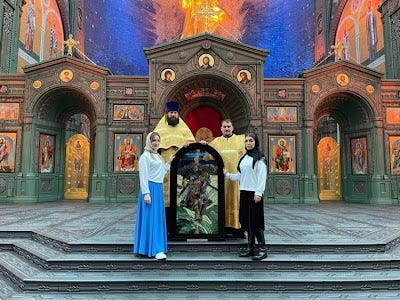
The discovery of the relic, however, did not create this parallel. Kulikovo had already been transported to Ukraine during the first year of the war. In the autumn of 2022, a stained-glass panel depicting the monk and warrior Alexander Peresvet, one of the legendary figures of the Kulikovo narrative, was unveiled in the Cathedral of the Resurrection of Christ, the main cathedral of the Russian armed forces. It had been made from shards of glass collected from battle sites in Mariupol. Katyusha, the patriotic women’s movement behind the stained-glass panel, explained its meaning: ‘Today, Mariupol is our new Kulikovo Field.’ Mariupol was described as the place where a ‘renewed Russian statehood’ had begun to take shape and where truth had prevailed. Four years later, Donskoy himself was sent to the same war.
Nor is the reuse of Donskoy in a modern war an invention of the Putin era. When Stalin addressed the Red Army in Red Square on 7 November 1941, with the German army close to Moscow, he called upon the soldiers to draw inspiration from their ‘great ancestors’. Among those Stalin named was Dmitry Donskoy. Stalin then invoked ‘the victorious banner of the great Lenin’.
The combination is remarkable. When its very existence was at stake, the revolutionary state that had overthrown the tsarist regime and fought against the Church could make the medieval Orthodox prince, generals of the tsarist era and Lenin parts of the same patriotic history. A regime can break with the institutions of the past while simultaneously laying claim to the victories of that past.
Donskoy leads the army at Kulikovo in 1380. Stalin invokes him in 1941. His name is given to Soviet tanks in 1944. Mariupol becomes ‘our new Kulikovo Field’ in 2022. In 2026, a fragment of what is claimed to be his sword hand is taken to the Ukrainian front. The Putin regime is therefore not merely reactivating Donskoy. It is also reactivating an older tradition of reactivating Donskoy.
Donskoy has also found a place in the modern Russian armed forces in a considerably less literal way. The last submarine of the Soviet Typhoon class bore his name. Even before it was decommissioned in 2023, the name Dmitry Donskoy had also been given to a new Borei-A-class strategic nuclear submarine, laid down in 2021. Here Donskoy finds himself in a curious historical company, alongside other submarines bearing names such as Vladimir, Oleg, Suvorov, Alexander III, Pozharsky and Potemkin.
Two Wars on the Same Battlefield
The Russian narrative of Ukraine can accommodate several historical wars at the same time. The Great Patriotic War of 1941–45 offers a narrative of existential defence against Nazism. It has been central from the very beginning of the invasion, through references to ‘denazification’, Bandera, Ukrainian nationalists and the Soviet victory of 1945. Kulikovo offers something partly different and older. Here, Nazism is not at the centre. The story is about fragmentation and gathering, foreign overlordship and independence, Moscow as a political centre, and a leader who gathers the Rus principalities for a historic struggle.
The Great Patriotic War serves above all to identify the enemy. Kulikovo helps to identify Russia itself. The first narrative says that we are the people who defeated Nazism. The second says something older still: that we are the historical collective that repeatedly gathers around its centre when external powers seek to divide or subjugate us.
Ukraine can simultaneously be the new Nazi Germany and the new Kulikovo Field. The West can simultaneously be the heir to Hitler’s attack and the ‘external force’ that, even in Donskoy’s time, is said to have sought to keep Rus in a state of subordination.
In his 1973 work Metahistory, the philosopher of history Hayden White examined how historical material is given narrative form. Among his analytical tools were the classical rhetorical tropes of metaphor, metonymy, synecdoche and irony. One need not accept White’s elaborate system of classification to see how useful some of these concepts are here.
‘Mariupol is our new Kulikovo Field’ is a metaphor. One battlefield is understood through the other. But Kulikovo also functions in an almost synecdochic manner. A single battle comes to represent a much larger historical whole: the rise of Moscow, the gathering of the Rus lands, and the long process that would later be narrated as liberation from foreign overlordship.
The relic concentrates this movement still further. A small fragment of bone comes to represent Donskoy. The hand is linked to the sword, the sword to Kulikovo, Kulikovo to victory, and victory to Russia’s historical restoration. A vast historical narrative has been condensed into a small piece of bone.
When the Story Becomes Material
The transfer of saints’ relics to Russian military units is not in itself unique to Donskoy. What is unusual is the specific significance attached to this particular fragment of bone. To the traditional religious meaning of a saint’s relic was added a specifically historical and military meaning. What matters is not merely that the fragment is said to come from Saint Dmitry Donskoy, but that it was identified as part of the hand that had held the sword at Kulikovo. The relic could therefore convey a message even to someone who was not a practising believer. It provides a link to a protective historical figure, a past victory and the idea of a Russia that will be victorious once again.
The finished narrative, however, has its inconvenient details. Two years after Donskoy’s victory on the Kulikovo Field, Moscow was burnt by the Mongol khan Tokhtamysh, who had in turn defeated Mamai. This does not mean that the battle lacked long-term significance, but it does show how selective the historical form must be if 1380 is to become the clear moment when Rus rises against foreign domination.
History is full of such complications. The narrative must choose which of them are to carry meaning. Donskoy was not a tsar. Still less was he an emperor. His place in this narrative precedes the later genealogy of Russian imperial power. Rather, he represents Moscow as a centre and a historical subject to which later forms of statehood can claim continuity.
The struggle can therefore be led by the prince, the tsar, the emperor, the general secretary or the president. The form of the state changes. The subject of the narrative is said to endure. That subject can be called Rus, the Russian land, the empire, the Soviet Union or the Russian Federation. This does not mean that they are historically the same state. It is the narrative itself that creates the continuity.
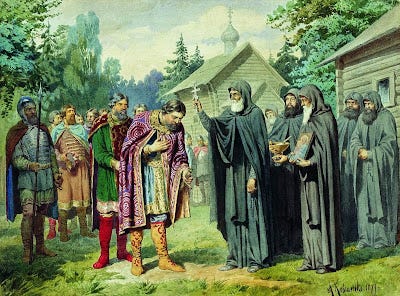
St Sergius of Radonezh Blessing Dmitry Donskoy before the Battle of Kulikovo.
Painting by Alexei Kivshenko, 1880.
Kulikovo takes the narrative further back than either the Soviet victory or the Russian Empire. It reaches back to a medieval and Christian Rus. Donskoy is not only a ruler and warrior but, since 1988, a saint. The narrative of Kulikovo is linked to Sergius of Radonezh and the warrior-monks Peresvet and Oslyabya. When a relic of Donskoy is taken to the front, the history is therefore not merely national and military. It is sacred.
The Church’s own language makes this clear. In September, it described the struggle as a defence of both the Fatherland and the Orthodox Church, while Donskoy was to assist today’s soldiers.
Here, two historical narratives can merge within the same religious language. ‘Nazism’ brings 1941–45 into the present. Donskoy and the sword hand bring in 1380. ‘Satanism’ places both within an even larger cosmic struggle between good and evil.
Tsargrad’s image of Donskoy and Putin does much the same thing visually. On one side are the medieval prince and his warriors; on the other, the president and today’s soldiers. The image need not say that Putin is Donskoy. It places them in corresponding positions.
But the relic goes one step further than the image. A portrait can place two eras side by side. The relic can be carried from one into the other. When Mariupol was called ‘our new Kulikovo Field’ in 2022, the relationship was metaphorical. When a fragment described in 2026 as part of Donskoy’s sword hand is taken to the present-day front, the historical analogy assumes material and ritual form.
A fragment of a nearly 650-year-old skeleton may seem a strange object to take to a modern war. But that is precisely why Donskoy’s sword hand reveals with unusual clarity how historical narratives work.
The relic brings more than the memory of a medieval prince to the front. With it come Kulikovo, the narrative of Moscow’s gathering of the former lands of Kievan Rus, resistance to foreign overlordship, and the idea of a victory that has already been won once before.
At the same time, another old war is under way. When Ukraine is to be ‘denazified’ and today’s Russian soldiers are portrayed as heirs to those who defeated Nazi Germany, the Great Patriotic War returns. When Mariupol becomes the new Kulikovo Field, Mamai becomes the leader of a Western proxy army, and Donskoy himself is said to take his place in the same battle ranks as today’s soldiers, an even older history returns.
The Narratives Become Interwoven
In the world of narratives, then, there is not just one war being fought in Ukraine. Kulikovo and the Great Patriotic War can be taking place there at the same time.
The two narratives do partly different work. The Great Patriotic War tells us above all who the enemy is: the Nazi, the aggressor, the existential threat. Kulikovo tells us something more fundamental about what Russia is supposed to be: a historical collective that is fragmented but repeatedly gathers around its centre, challenges foreign overlordship and restores its political agency. In the war in Ukraine, the two narratives become interwoven.
The leader may be a prince, tsar, emperor, general secretary or president. The adversary may be Mamai, Napoleon, Hitler or a West that is said to be waging a proxy war through Ukraine. It is not historical identity that creates the continuity. It is the narrative that assigns old roles to new people.
When Dmitry Donskoy’s sword hand is taken to the front, this narrative assumes an unusually tangible form. Six and a half centuries separate Kulikovo from the war in Ukraine. In the reliquary, they almost fit into the same hand.