

With the November 3, 2026, congressional midterm elections approaching, debate over Donald Trump’s foreign policy has once again intensified. Over the past few weeks, a rapid succession of White House decisions and public statements has intertwined energy, military support, and foreign policy demands in ways that have provoked strong reactions. Among the most significant developments are the so-called diesel deal with Russia and the temporary easing of sanctions to facilitate fuel trade. At the same time, the administration has granted waivers from enforcement of the new sanctions legislation recently passed by Congress and signed into law by Trump himself.
Trump has also announced an “energy ceasefire” intended to halt attacks on energy facilities, although its precise terms and whether both sides have agreed to it remain unclear. In these statements, the president has sharply criticized Ukrainian strikes on Russian oil refineries without directing comparable criticism at Russia’s continuing attacks on Ukrainian energy infrastructure. There have also been reports of restrictions on intelligence sharing and technical limitations on the Starlink and Starshield satellite services, although their exact scope and the chain of decisions behind them remain disputed. Accusations that Trump is doing Moscow’s bidding gained further traction when he publicly declared that Ukraine should replace its president to secure a final peace agreement. Media reports have also indicated that renewed trade in Russian energy and the reopening of Nord Stream are being discussed as elements of a broader deal.
Fuel prices and inflation give these decisions a clear domestic political dimension. In Trump’s rhetoric, responsibility for rising prices falls primarily on Ukraine’s attacks on Russian energy facilities rather than on the effects of the military conflict with Iran and the resulting disruptions to global oil supplies. Trump’s actions have been perceived as a betrayal of Ukraine and Europe, as well as of American interests. They have even been interpreted as an attempt to force Ukraine to capitulate on Russian terms, without credible security guarantees for the country or regard for European security.
These reversals have also been described as signs of impulsiveness and the absence of a coherent policy. Trump’s actions repeatedly give grounds for suspecting that he is doing Moscow’s bidding. Yet much of what appears to be a series of abrupt changes in direction becomes more understandable in light of views Trump expressed four decades ago.
The Man Doing Moscow’s Bidding
Suspicions about Trump’s relationship with Moscow have a much longer history than his recent decisions. Scrutiny surrounding the 2016 election and its aftermath brought renewed attention to his trip to Moscow and Leningrad in the summer of 1987, at the invitation of the Soviet ambassador to the United States. Shortly after the trip, he placed a full-page foreign policy advertisement in three American newspapers. That fall also saw the publication of The Art of the Deal, the book that cemented his public persona as an exceptional negotiator. The sequence is striking, but its significance remains disputed. It can be incorporated into several narratives about Trump’s relationship with the Soviet Union and later Russia, interpretations that differ in how they understand his intentions, independence, and susceptibility to influence.
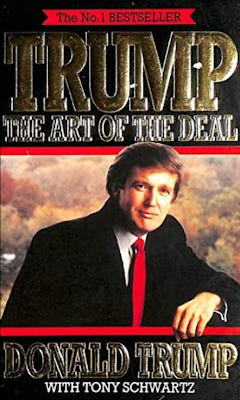
Trump: The Art of the Deal
Even if Trump is not a Russian asset in the intelligence sense, he is an asset to Russia. One common interpretation holds that Trump knows his actions benefit Moscow and accepts this because his own political or personal goals align with the Kremlin’s. Financial opportunities for himself or those around him are often cited as a possible incentive. Another common explanation involves pressure or outright blackmail. In this account, Russia possesses financial leverage or compromising material that induces Trump to act under implicit threats. A third explanation is that Trump is influenced through his own beliefs and self-image: he sincerely believes he is defending American interests, but his strong confidence in his own judgment, combined with a susceptibility to flattery and affirmation, leaves him open to being persuaded to make decisions that in practice serve the other side.
These three explanations for Trump’s accommodation of Moscow are not mutually exclusive, nor do they exhaust the possible interpretations. None can be established solely through Trump’s public statements. Those statements do, however, allow us to examine the self-understanding on which the third explanation rests and the continuity it reveals.
A Position of His Own Before the Moscow Trip
In a November 1985 interview in Manhattan, Inc., Trump outlined his ideas about how the superpowers should address nuclear proliferation. He proposed that the United States and the Soviet Union join forces to prevent other countries from acquiring nuclear weapons through economic pressure and ultimatums. Trump also sharply criticized France’s exports of nuclear technology and advocated strong economic pressure against the country. His inclusion of a close American ally shows that, in his view, alliance loyalties should not stand in the way of preventing nuclear proliferation. Moscow emerged here as a potential partner in achieving results.
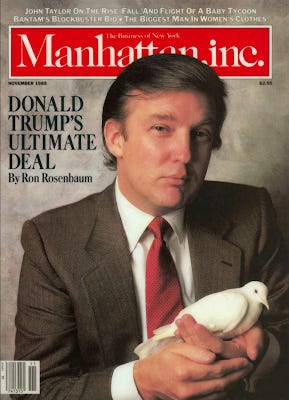
Manhattan, Inc., November 1985
As Washington and Moscow negotiate bilaterally over diesel deals or energy ceasefires in the fall of 2026, European and Ukrainian security interests are being handled in ways that reflect a distribution of roles similar to the one in Trump’s 1985 proposal. The interview also raises the question of whether Soviet diplomats and intelligence analysts were aware of his public proposals for superpower agreements. At the very least, it shows that he had publicly expressed views that could make him politically interesting. A political idea was thus already in place before the 1987 trip. But there was also an earlier conception of who was suited to put it into practice.
In a widely noted interview with The Washington Post in November 1984, the then 38-year-old Trump articulated his understanding of himself. He maintained that the ability to negotiate on major issues, including nuclear arms agreements, was innate, a talent one either possessed or did not. He downplayed the need for technical expertise by claiming that he could learn everything about missiles in an hour and a half. Trump suggested that he was suited to negotiate arms reductions with the Soviet Union despite his lack of experience in the field.
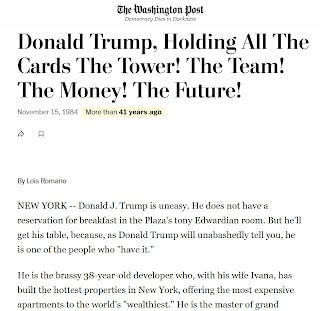
The Washington Post, November 15, 1984
An Invitation from Moscow
When contact was established with Soviet diplomat Yuri Dubinin in 1986, he was thus meeting an American businessman who had already publicly expressed both strong confidence in his negotiating ability and an interest in reaching agreements with the Soviet Union. These beliefs did not have to originate in Soviet influence to be encouraged and exploited.
The contact also had a concrete business basis, however. Under Mikhail Gorbachev’s reform policies, the Soviet Union sought Western capital and expertise. In January 1987, new opportunities were introduced for establishing joint ventures with foreign partners. The hotel industry was one area in which Western companies could contribute investment and experience. Trump was therefore a plausible business partner even without any intention of cultivating him as an asset.
According to Trump’s own account in The Art of the Deal, he received a letter in January 1987 from Dubinin, then the Soviet ambassador in Washington. The Soviet tourism organization Goskomintourist had expressed interest in a joint venture to build and operate a hotel in Moscow. On July 4, Trump traveled there with Ivana and two staff members. He was shown about half a dozen potential hotel sites, several near Red Square, and, according to his own account, stayed in “Lenin’s suite” at the National Hotel.
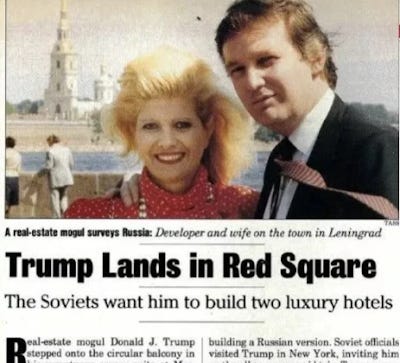
Newsweek, 1987
Trump described the visit as an extraordinary experience and emphasized how impressed he had been by the Soviet officials’ eagerness to make a deal. Published that same year, the account shows how he chose to portray his reception. The personal invitation, the accommodations, and the prospect of undertaking a major project near the Soviet Union’s center of power also provided a setting in which he could appear as an internationally significant businessman.
The clearest account of personal flattery, however, concerns the initial approach in New York the previous year. Dubinin’s daughter Natalia later described how her father’s admiration for Trump Tower and attention to its owner had appealed to Trump. She portrayed him as receptive to recognition. Her account offers a picture of how contact was established, but it is retrospective testimony and does not in itself establish that an intelligence operation took place.
Former KGB officer Yuri Shvets has gone further, describing how Trump’s susceptibility to flattery was deliberately exploited during the Moscow trip. Shvets’s account supports an interpretation of the visit as political cultivation, but does not establish that Trump was recruited or that his subsequent positions were dictated in Moscow.
No hotel was ever built, but the project’s failure to materialize shows neither that the business plans were a pretext from the outset nor that the contact lacked political significance. Commercial interest, diplomatic cultivation, and potential influence could coexist.
What also makes the trip particularly noteworthy is what followed. On September 2, 1987, Trump placed a full-page foreign policy advertisement in The New York Times, The Washington Post, and The Boston Globe. The Art of the Deal appeared in November. Together, the trip, the advertisement, and the book could help create the image of a businessman whose ambitions extended beyond real estate development. But to understand that image, we need to return to what the advertisement actually said.
The Exploited Nation and the Negotiator
Rereading the material from the fall of 1987 also reveals another narrative. Less than two months after his trip to the Soviet Union, Trump published his foreign policy advertisement. It portrayed the United States as a country paying for other nations’ security without receiving enough in return.

The New York Times, September 2, 1987
The advertisement can be read as an attack on American alliance policy that served Soviet interests. But it also expresses a way of understanding America’s relationship with the rest of the world that Trump would return to much later. The country’s problems are explained by others taking advantage of it and its own leaders allowing them to do so. Restoration requires someone who recognizes the injustice and can change the terms.
November saw the publication of the autobiographical book The Art of the Deal, written with journalist Tony Schwartz. It gave the decisive master negotiator a fully developed public persona. The advertisement identified the problem; the figure of the negotiator offered a possible solution. The man who already believed he possessed an innate talent for negotiation could also present himself as the one who would secure better terms for the United States.
The sequence of trip, advertisement, and book can therefore be understood in several ways. Commercial publicity, political ambitions, personal convictions, and outside encouragement may have interacted. But the narrative of an exploited America did not have to originate in Moscow to be useful there. An existing conviction may be easier to reinforce than to replace.
Two Victims and a Restorer
In earlier essays, I have described how the idea of an exploited United States combines with the narrative of Trump as a restorer. America has lost things it should rightfully possess: jobs, prosperity, respect, and freedom of action. Other countries have benefited from these developments, but responsibility is also assigned to American elites who have accepted or encouraged them. Trump offers a way back.
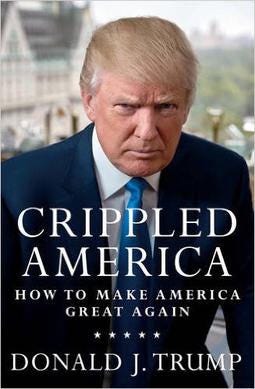
Crippled America, published in 2015
This does not necessarily mean that all his supporters see themselves as personal victims. They may identify with the nation or with a cultural and social community whose standing is seen as having weakened. The promise of restoration thus brings together people with different experiences and political priorities.
Trump himself also takes his place among the victims. Attacks on him can be portrayed as attempts to prevent him from defending the country and its citizens. His personal setbacks become part of the same conflict his policies are said to address. The man seeking to restore America is persecuted by the forces that previously betrayed it.
This narrative also offers a way to counter suspicions about his Russian ties. The accusations can be understood as yet another attempt to discredit someone who challenges the establishment. The continuity in his position then takes on the opposite meaning from the one it carries in the narrative of suspicion. For critics, it may raise questions about longstanding influence. For supporters, it may show that Trump has long recognized things others are only now being forced to acknowledge.
This does not mean that all criticism of him is justified. Unfounded accusations and sweeping insinuations can lend concrete support to the perception that he is being treated unfairly. But the same narrative can also be used to dismiss well-founded objections. The fact that Trump is sometimes treated unfairly does not establish whether his assessment of Putin or the war in Ukraine is correct.
When the Other Side Affirms the Narrative
The third explanation for Trump’s accommodation of Moscow is compatible with this self-understanding. He may sincerely wish to defend American interests while remaining susceptible to influence that leads in a different direction.
Examining that possibility does not require a clinical diagnosis of narcissism. Self-absorption, grand claims about one’s abilities, and a publicly expressed need for recognition can be described and analyzed without diagnosing a personality disorder. Public behavior can also be both personal expression and deliberate performance. The showman’s ability to attract attention has been an asset in entertainment and political mobilization.

Trump the showman in The Apprentice
The question is what happens when this same style encounters a negotiating counterpart who offers carefully tailored recognition. Someone who shows respect for Trump’s abilities may appear constructive and open to negotiation. Someone who questions his judgment may instead appear to be an obstacle to the agreement he believes he can achieve.
It is important not to interpret every respectful gesture as manipulation. Trump has also defended the way he speaks about Putin by arguing that one should not insult someone one is negotiating with. Keeping talks open is an understandable diplomatic ambition. But continued contact, a good personal relationship, and concrete political results are different things. Success in one cannot automatically be taken as evidence of success in another.
Here, the connection between the individual and the nation becomes significant. When respect for Trump comes to stand for respect for the United States, a counterpart’s appreciation can take on a broader meaning. It becomes a sign that America once again has a leader the world takes seriously. The recognition then affirms both the master negotiator and the restoration.
In European capitals, Trump’s phone calls with Putin are a recurring source of anxiety: will previous commitments and shared positions still hold once the call is over? Following a call in February 2025, European officials voiced fears of a deal struck over the heads of Ukraine and Europe. In May of that year, Reuters reported that, according to a European diplomat, Trump had first agreed with European leaders to demand an unconditional ceasefire and impose further sanctions if Russia failed to cooperate, only to abandon that approach after speaking with Putin.
Such reversals do not prove manipulation, but they make the suspicion understandable. Nor does influence necessarily have to be limited to flattery. The Russian side may offer explanations and courses of action that resonate with Trump’s existing convictions, allowing him to experience the conclusions as insights of his own.
Just as a magician can steer someone’s choice of a card without the participant feeling any loss of freedom, a skilled negotiator can try to shape the possibilities a counterpart sees while leaving that person feeling entirely independent. In this interpretation, Trump’s confidence in his intuition could become a vulnerability: the conviction that he has seen through the situation himself may make it harder to recognize how the other side has shaped his understanding of it. The tragic possibility is that Trump experiences the treatment as recognition of his ability, while the other side sees it as a way to steer the master negotiator.
This can also create a dilemma for advisers and intelligence officials. Information that the other side does not intend to make the expected concessions is a factual assessment, but it may also challenge the president’s judgment of the relationship and his own abilities. How can such a warning be conveyed without the messenger joining the ranks of those who supposedly fail to understand his success or refuse to let him achieve it?
During Tulsi Gabbard’s tenure as director of national intelligence, the defense of the president’s narrative also found a place within the institution tasked with providing him with information about the outside world.
Self-presentation alone cannot establish that a particular attempt at manipulation has succeeded. It does, however, make it possible to examine a vulnerability. A counterpart need not persuade Trump to abandon his narrative about America. It may be enough to offer him a prominent and successful role within it. When the president of the world’s leading power makes the narrative of national restoration dependent on recognition of his own abilities, the need for personal affirmation can become a national vulnerability.
Continuity Through the Reversals
Against this background, Trump’s actions in the fall of 2026 become understandable even without assuming that Russia has leverage over the American president. Sanctions can be presented as evidence of strength, while sanctions relief becomes a way to open the door to a deal. Both can find a place in the narrative of the skilled negotiator. This does not mean the decisions are consistent or achieve their goals. But the reversals need not reflect changes in his underlying self-understanding.
The diesel deal also connects with the older message about costs borne by American citizens. When high prices are attributed to Ukraine’s attacks on Russian refineries, Ukraine is cast as the party making life more expensive for American consumers. His own Iran policy’s contribution to the energy crisis receives less attention. A concession to Russia can thus be presented as an action taken for Americans’ benefit.
The demand for a peace agreement can assign roles in the same way. If Putin is portrayed as willing to make a deal while Zelensky rejects the terms, the Ukrainian president becomes the one standing in the way of peace. Europe’s continued support can then be described as what makes that resistance possible. The possibility that Ukraine and its supporters may have security reasons for rejecting a particular agreement risks being left out of the explanation.
Trump’s view that Europe should bear more of the cost of its own defense does not, by itself, explain this conflict. When Europe actually funds support yet this is still perceived as an obstacle to a deal, the disagreement also concerns who gets to set the terms and what outcome should count as a success.
Here, a distribution of roles recognizable from 1985 reappears. Moscow can be the partner in an agreement, while allies are expected to adapt. There are major differences between the nuclear issues of that era and today’s war. But the idea that the great powers can produce a solution by reaching an agreement with each other has a long history.
The attack on Iran can also be interpreted in light of Trump’s early interest in preventing nuclear proliferation. Within this worldview, accommodation of Moscow and military confrontation with Tehran need not be contradictory. Russia is a great power with which the United States can negotiate the international order, while Iran is a state whose nuclear ambitions must be constrained. Respect for Moscow can therefore also be understood as recognition of its great-power status, with its nuclear arsenal giving Russia particular weight despite its much weaker economic position relative to the United States.
This continuity does not make the United States predictable to its allies. It may, however, help explain why pressure on allies and accommodation of Moscow need not appear contradictory within Trump’s own account.
Recognition Withheld
At a campaign rally in South Carolina on October 21, 2026, where his task was to support the local Republican Senate candidate, Trump devoted most of his appearance to his own achievements and the recognition he believed he had been denied. He portrayed himself as having ended eight wars and declared that two more, the war between Russia and Ukraine and the war against Iran, were nearing their end. These promised endings were thus also incorporated into the narrative of his own peacemaking successes and the recognition he believed he had been denied.
Trump spoke about the Nobel Peace Prize, which he believed he should have received but had not, and about the Pulitzer Prize. Journalists had been rewarded for reporting on Russia, specifically Russian interference in the 2016 U.S. presidential election, that he claimed was wrong. Trump also said that he himself should have received a Pulitzer for his writing.
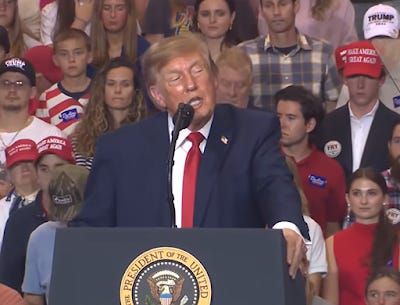
South Carolina, October 21, 2026
Several elements of the narrative came together here: exceptional ability, achievements others refused to acknowledge, and institutions rewarding the wrong people. We cannot know what Trump thought about the Peace Prize in the 1980s. But the ambition to use his particular negotiating ability to avert nuclear war was already present. His current claims to recognition thus concern an ability he attributed to himself four decades earlier.
Yet this episode, too, could be incorporated into the narrative of the man doing Moscow’s bidding. When Trump claimed that the prizewinning journalists had been wrong, one news website interpreted his remarks as a possible hint of insider knowledge. That conclusion did not follow from the words quoted. But it showed how his self-defense could provide fresh material for suspicion.
At such moments, Trump seeks to reclaim the image of himself as clear-sighted and unfairly treated. Outside the audience that already shares his narrative, the appearance may take on a different meaning. Complaints about prizes he has not received hardly provide, in themselves, a compelling reason for more Republican voters to turn out. They may, however, reinforce his opponents’ image of an unlikable Republican president who puts his own vindication ahead of other concerns, or is even a Russian asset. Applause in the room does not necessarily translate into an electoral advantage.
It is possible to see something sorrowful in this as well. The man who, even in his youth, imagined he could help save the world from nuclear war returns four decades later to the world’s failure to recognize his ability. At the same time, his own claims and actions give critics fresh reasons to question him.
Trump may portray himself as a victim of unfair treatment by others, but he may also become a victim of the very narrative meant to explain that treatment. If objections to his judgments are absorbed into the narrative as further expressions of hostility, it becomes harder to distinguish them from warnings he genuinely needs to take seriously.
The ambition to restore American strength may be sincere. Yet personal affirmation that America is back may coincide with a weakening of allies’ trust and America’s ability to rally others. Rivals may seek to exploit precisely this image of the exceptional negotiator and restorer to further that process.
Trump need not compromise his own narrative or his patriotism to do Moscow’s bidding. On the contrary, he may cling so tightly to his narrative that he struggles to see when his efforts to restore America’s greatness undermine what still sustains it.