
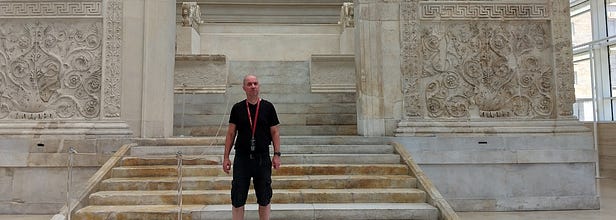

On 7 September 2026, the Yakov Novichenko Bridge across the Tumen River between Russia and North Korea was inaugurated. As the bridge opened, convoys of lorries from both countries crossed the border. Leading the Russian convoy was a red Zaporozhets, manufactured in Zaporizhzhia, Ukraine. The car had belonged to the Soviet officer Yakov Novichenko, and his grandson Nikolai Shcherbitsky was behind the wheel as it rolled towards North Korea.

The bridge and road link between North Korea and Russia had been agreed during Vladimir Putin’s visit to the North Korean capital, Pyongyang, in June 2024. By then, Russia’s need for ammunition for its war in Ukraine had given North Korea a new significance as a military supplier. In October that year, the North Korean military blew up the road links to South Korea.
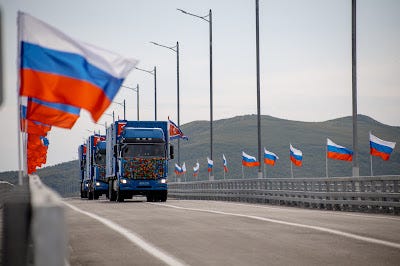
The bridge is named after a Soviet officer credited with saving Kim Il Sung’s life by catching a grenade and covering it with his body during a mass rally in Pyongyang in 1946. The Great Leader later showed his gratitude to Novichenko during his state visit to the Soviet Union in 1984 by awarding the hero, forgotten in his own country, the North Korean title of Hero of Labour. In other respects, Kim Il Sung and the North Korean state have downplayed the Soviet Union’s role in bringing Kim and his family to power.
During the Second World War, while Korea remained under Japanese colonial rule, Kim Il Sung served in the Red Army. Following Japan’s defeat in 1945, the Soviet Union occupied the peninsula north of the 38th parallel, including Pyongyang. With decisive Soviet support, Kim established himself as the leader there and became head of government when the Democratic People’s Republic of Korea was proclaimed in 1948.
According to North Korean historiography, Kim Il Sung had liberated Korea from Japanese colonial rule through his guerrilla struggle. His leadership was presented as an expression of the people’s trust in their liberator, and the new state as the outcome of his revolutionary struggle. In this account, Soviet efforts play a subordinate role as fraternal support.
During the Korean War, it was the People’s Republic of China that came to Kim Il Sung’s rescue after the US-led UN forces had driven back the North Korean army and approached the Chinese border. Although Kim had led his people into a war that devastated Pyongyang and other cities, he tightened his grip on the population during the 1950s, while the personality cult surrounding the “Great Leader” grew ever more pronounced. A combination of repression and intense, quasi-religious reverence for the leader, and later for his son Kim Jong Il, the “Dear Leader”, cemented the Kim family’s hold on power.
When I had the opportunity to visit North Korea with my future wife in 1992, I nevertheless expected the regime to fall within a few years. The Soviet Union had dissolved the previous year, and Germany had been reunified two years earlier. I took the very possibility of visiting North Korea as a sign that the country was beginning to open up, even though travelling from the South Korean capital, Seoul, to its northern counterpart, Pyongyang, required us to fly via Nagoya in Japan.
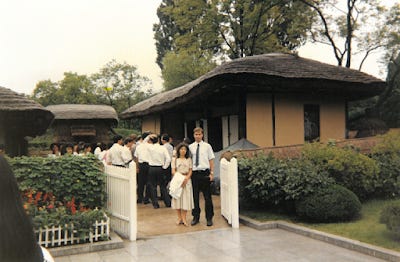
During our trip, we visited Mount Kumgangsan, where slogans were being carved into rock faces. We also made an obligatory visit to the “cradle of the revolution”, Kim Il Sung’s purported birthplace in Mangyongdae. There we had our photograph taken beside the very modest traditional Korean farmhouse, with its earthen walls and thatched roof, where Kim Il Sung is said to have been born on 15 April 1912 — or in year 1 of the calendar officially introduced in North Korea in AD 1997.
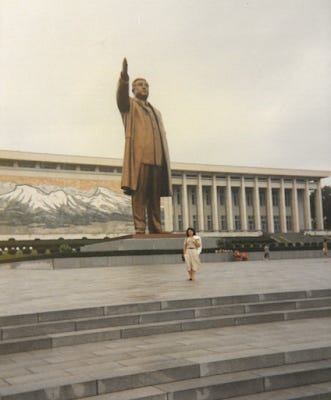
In Pyongyang, we also visited the monument on Mansu Hill, with its 22-metre statue of the Great Leader, unveiled twenty years earlier to mark Kim Il Sung’s sixtieth birthday. In 1992, the statue had not yet been joined by one of Kim Jong Il. That was added only in 2012. When Kim Il Sung died in July 1994, it was particularly from the monument bearing the late leader’s statue that the striking images of Koreans weeping uncontrollably were broadcast around the world.
When Kim Il Sung died, he was succeeded as the country’s leader by his son Kim Jong Il, who had long been known as the “Dear Leader”. Yet the father retained his status: in 1998, the constitution was amended and Kim Il Sung was designated the republic’s Eternal President. His son governed through other offices.
I was not alone in imagining a reunified Korea in the early 1990s. But the reunification I envisaged, following Germany’s example, had a different meaning from the one promised in North Korea. There, according to North Korean historiography, Kim Il Sung had liberated the people from Japanese colonial rule, but that liberation was presented as incomplete. The southern part of the homeland remained under the domination of American imperialism. Reunification would complete the nation’s liberation.
The story of liberation already achieved was thus complemented by the promise of liberation yet to come. Between the two, continuing trials and sacrifices could acquire meaning. In this sense, the reunified homeland served as a promised land.

At the 1991 World Table Tennis Championships, North and South Korea fielded a joint team for the first time. They used the Unification Flag, a sky-blue silhouette of the Korean peninsula against a white background. The same flag was carried during joint marches at the opening ceremonies of the Sydney Olympics in 2000, Athens in 2004, Turin in 2006 and the Pyeongchang Winter Olympics in 2018, when North and South Korea also fielded a joint women’s ice hockey team. The map of the entire Korean peninsula has also been used in various official contexts in North Korea.
In a text on reunification published in August 1997, Kim Jong Il returned to the liberation that, according to the official account, his father had bestowed on the nation. Yet full national sovereignty could be achieved only through reunification: foreign domination in the south would end, and the nation’s severed ties would be restored. Completing the liberator’s work was presented as a revolutionary duty and a moral obligation, whatever difficulties remained. The liberation already achieved thus both conferred authority on the leadership and gave direction to the continuing struggle.
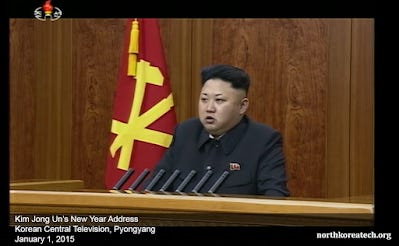
These themes were still combined in Kim Jong Un’s New Year address in 2015. The seventieth anniversary of liberation became an occasion to call on the entire nation to work towards reunification. At the same time, hostile US policy was portrayed as a threat to the country’s existence, and nuclear deterrence as a necessary defence of its sovereignty. Historical liberation, future reunification and defence against external enemies thus appeared in the same speech.
Some authoritarian states suppress opposition through political killings, prison camps, torture, punishment of family members and other forms of repression. Yet they generally still need to legitimise their power, including through history and grand narratives. In North Korea, brutal repression and the persecution of Christians are combined with systematic indoctrination in Juche ideology, which emphasises national independence and self-reliance, as well as the leader’s central role. Broadly speaking, three narratives have legitimised the regime: Kim Il Sung freed the people from bondage under Japanese imperialism; under his leadership and that of his successors, the people have defended the freedom they won; and future reunification would complete their liberation by ending what the regime portrayed as US domination in the south.
The three narratives are interconnected, but also complement one another through their partly distinct functions. It is above all the liberation already achieved that gives the regime historical legitimacy. Defence against enemies explains why the victory must still be protected and why the trials continue. The promised completion of liberation gives direction and meaning to the continuing struggle and sacrifices. The three narratives can also be interpreted as parts of a single grand narrative, sharing the basic structure of the biblical account of the exodus from Egypt, the wandering in the wilderness and the arrival in the promised land.
This narrative form is not unique to North Korea. Marxism’s philosophy of history has also been interpreted as a secularised history of salvation: revolution opens the way to liberation, but does not in itself bring about a fully realised communist society. The promise of this future fulfilment can legitimise a dictatorship presented as a necessary transitional stage. In North Korea, the promise of a communist future has been combined with that of the nation’s complete liberation through reunification. The word “communism” was removed from the constitution in 2009, and the goal of building a communist society was removed from the party charter in 2010, before being reinstated there in 2021. The promise of reunification as the completion of national liberation remained even when the ultimate communist goal was no longer explicitly stated. It could thus continue to give direction and meaning to the people’s sacrifices.
The parallels with biblical narratives need not be coincidental. Kim Il Sung grew up in a devout Christian household in Pyongyang, which became known in the early twentieth century as the Jerusalem of the East thanks to exceptionally successful Protestant missionary work and an intense spiritual awakening. In his book Korean Messiah, published in spring 2026, Jonathan Cheng describes how Kim Il Sung taught Sunday school, played the church organ and spoke at events organised by the YMCA. According to Cheng, the personality cult was strongly shaped by Christianity. Cheng also notes that Kim Il Sung presented himself to Pyongyang’s Christian population as a Moses-like figure who had led the people out of bondage under Japanese rule.
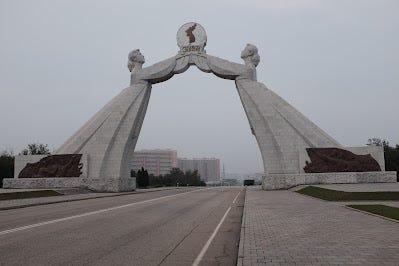
One of my clearest memories of North Korea is a bus journey along a virtually empty motorway. The few vehicles we encountered were mostly lorries carrying passengers on their open flatbeds. The road was kept clean by people sweeping it by hand with twig brooms. That same year, 1992, the motorway between Pyongyang and Kaesong, near the border with South Korea, had been inaugurated to mark the Great Leader’s eightieth birthday. Among foreign visitors, it became known as the Ghost Highway because of its almost complete lack of traffic. In North Korea, however, it was called the Reunification Highway, or Tongil Gosokdoro. In 2001, the Arch of Reunification — officially the Monument to the Three Charters for National Reunification — was inaugurated over the highway on the southern outskirts of Pyongyang.
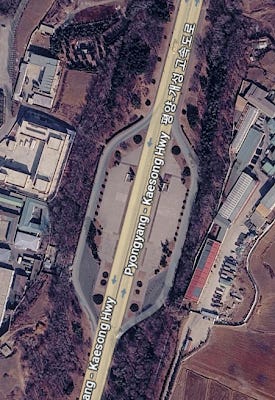
In January 2024, the Arch of Reunification was demolished. The monument to the Great Leader’s vision of the future had become an obstacle to his grandson’s new policy. Satellite images showed that the arch had disappeared by 23 January.
At a party meeting in late December 2023, Kim Jong Un had declared that relations between North and South Korea should no longer be understood as relations within a single nation, but between two hostile states. In a speech to the Supreme People’s Assembly on 15 January 2024, he drew out the implications of this redefinition. The bodies responsible for reunification were abolished, and he demanded the removal of references to peaceful reunification from the constitution. The population was instead to be taught to regard South Korea as the country’s principal and permanent enemy.
This marked a break with a goal that had been presented as both the founder’s last wish and the nation’s historic task. The liberation already achieved was still to be revered and the state still defended, but that defence no longer had to serve the goal of a reunified homeland. The promised land had been removed from the itinerary.
The break did not, however, mean that Kim had relinquished the possibility of conquering the south. In the same speech, he proposed that the constitution should provide for South Korea to be occupied and incorporated into the North if war broke out. The difference lay in how the goal was narrated: the south would no longer be reunited with the north as part of the same nation, but could be subjugated as a hostile state.

The change took concrete form when North Korea blew up the road links to South Korea in October 2024. That same month, state media stopped using the year-numbering system that counted the years from Kim Il Sung’s birth. This has been interpreted as an attempt by Kim Jong Un to establish an authority less dependent on his predecessors’ legacy. Nuclear weapons may have made it easier to abandon the goal of reunification and centre the regime’s legitimation on the defence of its own state. Cooperation with Russia may also have facilitated this shift.
The greater the sacrifices demanded of the people, the more important the promise of a future goal may become in justifying those sacrifices and giving meaning to the struggle. Once reunification is no longer promised, the question arises of what is to motivate people to endure further trials. Defence against external enemies can still be invoked, but the regime may also need to demonstrate results within the state now presented as the people’s entire homeland.
The abandonment of reunification during a period of economic recovery and stronger diplomatic ties need not be the result of a deliberate calculation. But if the elite in Pyongyang perceives the country as making progress and gaining greater respect internationally, this may make it easier to break with a goal that was central to Kim Il Sung’s legacy.
Despite Juche ideology’s emphasis on national independence, North Korea has long depended on support from its larger neighbours. The Soviet Union helped bring Kim Il Sung to power, and China saved his regime during the Korean War. The war in Ukraine, however, has given North Korea something Russia needs: ammunition and soldiers. The longstanding relationship of dependence has thus become more clearly reciprocal.
Cooperation with Russia may therefore have made it easier to legitimise the regime without the promise of liberating the entire homeland. Military strength, economic progress and a sense of greater international recognition can give the leadership other successes to invoke and lend meaning to the people’s continuing sacrifices.
Yet this room for manoeuvre may prove dependent on Russia’s continuing needs and ability to pay. If the exchange diminishes and the trials intensify again, the question will be what is to give them meaning once reunification has ceased to be the promised fulfilment of the Korean people’s liberation. The defence narrative can motivate continued struggle, but does not in itself promise an end to it.
North Korea lends itself to this analysis because the regime’s extreme features make the functions of legitimising narratives unusually clear. Russia is more complicated. There, the legacy of the princes of medieval Rus is combined with the legacies of Peter the Great and Stalin. Ideas of the Soviet Union’s lost great-power status overlap with the imperial legacy, claims to a Russian civilisational community, Russkiy mir, and the Moscow Patriarchate’s ecclesiastical claims over all Rus. These ideas do not form a single, unambiguous narrative, nor do they necessarily imply the same territorial goals.
As the war in Ukraine has dragged on and the promised restoration has met resistance, the defence narrative has gained greater weight. Russia is portrayed as under attack from a hostile outside world, with Ukraine serving as an instrument of the West. This does not mean that expansionist goals have been abandoned. In both Russia and North Korea, the defence narrative can be combined with claims to a neighbouring country’s territory.
The difference is that North Korea has explicitly abandoned reunification as a national goal, while Russia continues to combine restoration and defence. The defence narrative can also make setbacks intelligible: it is no longer merely Ukraine that must be defeated, but an overwhelmingly powerful West that must be resisted. Continuing sacrifices can thus be presented as necessary even when the promised success is slow to arrive.
Historical images of the enemy acquire a particular function here. If today’s opponents are portrayed as heirs to yesterday’s Nazis, the earlier victory can lend moral authority to the continuing struggle. The liberation narrative and the defence narrative are then bound together through the image of an enemy that keeps returning.
For North Korea, Russia’s war has opened a route out of diplomatic isolation. A state long treated as an international pariah has become a sought-after military partner. Relations with the outside world can become more normal in this limited sense, while indoctrination and brutal repression persist.
Russia’s development is moving in the opposite direction in other respects. The war and the rupture with the West have increased its dependence on a smaller number of partners, including North Korea. At home, repression, indoctrination and militarisation are becoming more important. At the same time, the regime’s legitimation rests increasingly on the narrative of a threatening outside world. The histories of neighbouring countries are used to portray them as enduring enemies, with a “Nazi” past supposedly living on in their present-day politics.
Russia is thus acquiring increasingly pronounced North Korean characteristics. The North Korean model brings into sharp focus a development in which preserving power takes precedence over the population’s welfare, and a promised restoration is increasingly supplemented by the demand to defend the country against external enemies. The prospect of future success can be deferred, while the threat justifies sacrifices here and now.
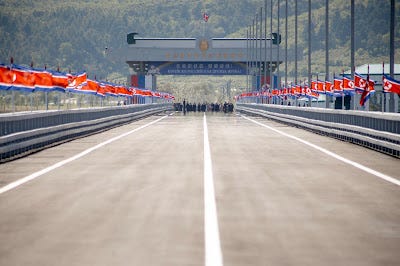
The Yakov Novichenko Bridge thus connects more than two countries. Through Russia, North Korea gains an opening to the outside world, while Russia is, in some respects, moving towards North Korea. The Soviet officer who saved Kim Il Sung has given his name to a bridge linking North Korea to a Russia that is now itself dependent on the North Korean regime.
The red Zaporozhets rolled towards North Korea. Russia is following.