


Bandera and Azov: the Image of a Nazi Ukraine
When Russia launched its full-scale invasion of Ukraine in February 2022, Vladimir Putin named ‘denazification’ as one of the war’s objectives. Yet the image of a Nazi Ukraine had been cultivated long before then. Two recurring reference points have been the historical nationalist leader Stepan Bandera and the contemporary military formation Azov, with its far-right origins.
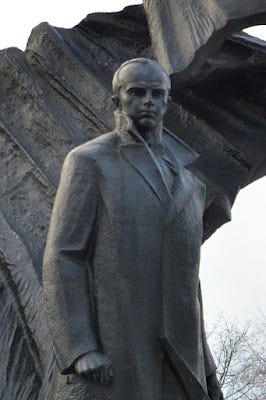
Statue of Stepan Bandera in Ternopil
Understanding how these names function as political weapons requires clear distinctions. The historical activities of Bandera and his organisation, his subsequent symbolic role in Ukraine and Russia’s use of his name are separate questions. Similarly, we must distinguish between Azov’s far-right origins and symbolism, the limited electoral success of the movement associated with it and the significance attributed to the military formation in Russian rhetoric. Historical realities and controversies have been used to justify the claim that the entire Ukrainian state, and in more sweeping accounts even the population, needs to be ‘denazified’.
In recent decades, Bandera has acquired significance as a contested symbol of the Ukrainian struggle for independence. He led a faction of the Organisation of Ukrainian Nationalists, or OUN, whose authoritarian nationalism and involvement in atrocities make its legacy deeply controversial. For some who invoke him today, however, his name may primarily signify the struggle for Ukrainian independence and resistance to Moscow. Using the symbol therefore need not imply subscribing to his political ideas, although it may help to sanitise the history he represents. Russian rhetoric erases these distinctions: invoking his name is itself treated as evidence of Nazi convictions.
Azov was incorporated into Ukraine’s National Guard in November 2014. The formation was placed under the National Guard’s chain of command and subsequently developed through professionalisation and broader recruitment. Scholars have differed in their assessments of how far its ideological transformation went and how strong its ties to the far-right movement remained. Its incorporation does not, however, support the conclusion that Ukraine’s entire defence establishment adopted Azov’s ideology. In Russian accounts, the same organisational change can nevertheless serve as evidence for precisely this conclusion: incorporation is said to have spread the formation’s ideology throughout the state apparatus.
The movement associated with Azov had very limited parliamentary success. In the 2019 parliamentary election, the National Corps party was part of a joint nationalist electoral list that received just over two per cent of the vote, failing to clear the five per cent threshold. This weak electoral support did not, however, prevent Russian rhetoric from using Azov and Bandera to portray the government in Kyiv as a fascist or Nazi junta.
When the Part Stands for the Whole
Bandera, who was murdered in exile by a KGB agent, has for decades been an established enemy figure in Soviet and Russian rhetoric. Azov has provided contemporary names, symbols and imagery that could be incorporated into this older framework. Together, they serve to embody the notion of an unbroken Nazi continuity from the Second World War to present-day Ukraine.
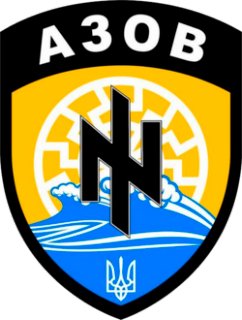
Bandera and Azov have also helped shape perceptions of Ukraine in the West. Legitimate scrutiny of historical atrocities and contemporary far-right extremism has existed alongside sweeping generalisations about the Ukrainian state. In some circles, the Kremlin’s overall portrayal has also been accepted.
This illustrates a fundamental challenge in narrative warfare and psychological defence. A narrative can draw on accurate information and still be deeply misleading through selection, exaggeration, generalisation and the omission of context. The question, therefore, is not simply what is true about Bandera and Azov, but how these truths and controversies are used to cast an entire country as Nazi, thereby recasting an invasion as a supposed liberation.
The Promise of Restoration, with Crimea as the Model
To understand the function of the accusations of Nazism, we must also consider the broader narrative of restoration. The annexation of Crimea in 2014 offered a model: in the Russian account, a historical wrong had been righted, the national community restored and the leadership’s capacity for decisive action affirmed. When the full-scale invasion began in 2022 with the stated objectives of ‘demilitarisation’ and ‘denazification’, several narratives worked together. A brotherly people was to be reunited with the Russian community, the population liberated from supposedly illegitimate rule and a military threat eliminated. The defensive narrative was thus present from the outset, alongside the promise of restoration.
Within this allocation of roles, the United States was portrayed as the dominant, hostile power behind the government in Kyiv, while Ukraine was cast as its instrument. Germany occupied a different position. Its extensive economic ties with Russia and dependence on Russian energy gave Moscow leverage and could favour a continued cautious German approach.
By distinguishing between the people, the government and external powers, the rhetoric could reconcile the image of a closely related, brotherly people with that of a hostile Ukraine. The population was said to be held captive by a regime serving foreign interests. The invasion could thus be presented both as the liberation of Ukraine and as the defence of Russia.
Setbacks Become a Problem of Credibility
As the full-scale war dragged on, the contradictions in the liberation narrative became increasingly apparent. Why was the population defending the state whose leadership was supposedly holding it captive? Why had rapid successes failed to materialise, and how were continuing sacrifices to be justified?
An early example of how Ukrainian resistance could be incorporated into the enemy image is Timofey Sergeytsev’s article ‘What Russia Should Do with Ukraine’, published by the state news agency RIA Novosti on 3 April 2022. Here, ‘denazification’ encompassed not only the political leadership but also large sections of the population and their national identity. Sergeytsev explicitly rejected the notion that the people were good but those in power were evil. In his view, denazification must also entail de-Ukrainisation. The population’s support for its own state could thus be presented as evidence of how widespread Nazification had become.
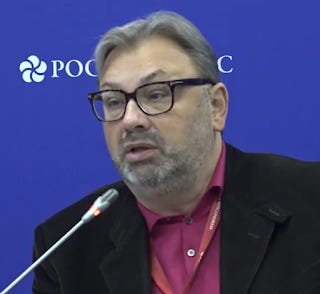
Timofey Sergeytsev
The article shows how far this argument could be taken on a state media platform, although the article alone cannot establish its relationship to the Russian leadership’s shifting emphases. The shift towards a defensive narrative can be understood against the backdrop of the credibility problem created by the protracted war. When swift restoration failed to materialise, the ability to hold out against a powerful West could be presented as an achievement in itself, while restoration remained a more distant ultimate goal.
The Great Patriotic War
An established historical framework already exists for this defensive narrative. The memory of the Great Patriotic War has long been central to the Russian state’s claims to legitimacy and was invoked at the very outset of the full-scale invasion. Victory over Nazi Germany offers a ready-made plot: Russia as the heir to a Soviet Union that had suffered invasion but ultimately emerged victorious, Russia’s own armed forces as liberators, the adversary as the embodiment of a historical enmity, and the sacrifices as morally necessary.
The narrative also draws its power from lived experience. The war brought immense losses, destruction and suffering, and its memory lives on in family histories and public commemorations. When today’s leadership invokes victory, it therefore appeals to more than an official account of history. It can connect its own policies with the grief, pride and moral weight of earlier generations’ sacrifices.
Yet claiming this inheritance also involves selective appropriation. The Soviet victory was not exclusively Russian. Ukrainians and other peoples also took part in the struggle and suffered under Nazi Germany’s occupation and policies of extermination. When present-day Russia presents itself as the principal heir to victory, this shared past can be turned into a moral dividing line between Russia and its neighbours. Ukraine’s resistance to the Russian invasion is then placed on the opposing side of a victory that also belongs to Ukraine’s history.
The narrative’s timeframe matters too. The Great Patriotic War begins with the German attack in 1941. When this framework comes to stand for the entire history of the Second World War, the Molotov–Ribbentrop Pact, the attack on Finland and the Soviet occupation of the Baltic states fall outside the picture. For Finland and the Baltic states, the history of the war therefore encompasses experiences that have no place in a narrative casting the Soviet Union solely as a victim of aggression and a liberator.
In this context, the accusation of Nazism assigns roles to both sides. If the adversary is Nazi, Russia can once again appear as the power that defends and liberates. The question of who started the present war can then be displaced by the notion of which historical struggle it belongs to.
This plot can also give meaning to a protracted war. Setbacks need not disprove the narrative; they can instead testify to the enemy’s strength and the need for endurance. Ukraine’s foreign supporters can, in turn, be written into the same struggle. The enemy image thus expands from a supposedly Nazified Ukraine to a Europe in which old enemies are said to return in new guises.
Finland and the Baltic States: Historical Guilt Transferred to Today’s Neighbours
This expanded enemy image is evident in the treatment of Finland and the Baltic states. In Russian rhetoric about Finland, previously pragmatic relations have increasingly given way to historical accusations. Finland’s fighting alongside Nazi Germany during the Continuation War (1941–1944) is used to interpret its present-day security policy. During a visit to Karelia in July 2023, Nikolai Patrushev, then Secretary of Russia’s Security Council, explicitly linked Finland’s supposedly anti-Russian course to its wartime conduct. Patrushev claimed that ‘extremist and nationalist organisations’ seeking to reclaim the lost territories in Karelia were becoming more active in Finland. In August 2024, the Supreme Court of the Republic of Karelia in Petrozavodsk declared that the actions of the Finnish occupation authorities in Eastern Karelia constituted ‘genocide’.
The abuses and internment camps of the occupation are historical realities. At the same time, there have been attempts on the Russian side to attribute other crimes to Finland. One example is the claim that the Sandarmokh burial site in Russian Karelia, where victims of Stalin’s terror are buried, also contains Soviet prisoners of war executed by the Finnish army. These claims lack sound historical support and divert attention from Soviet terror towards alleged Finnish crimes. Within the broader enemy image, both well-documented abuses and historical falsification can be used to portray hostility towards Russia as an enduring Finnish characteristic. NATO membership and the closure of the eastern border can then be described as new expressions of an old ‘Russophobia’.
The same pattern recurs in portrayals of the Baltic states. In February 2024, it emerged that Russia had placed Estonian, Latvian and Lithuanian political figures on wanted lists over the removal of Soviet monuments. Commemorations in Riga honouring the Latvian Legion of the Waffen-SS are also used to support accusations that Nazism is being rehabilitated. Disparate phenomena are thus woven into an overarching image of states perpetuating a Nazi legacy.
In this portrayal, the Baltic experiences of Soviet occupation are pushed aside. Rejection of Soviet rule is instead made to signify support for Nazism. The actions of historical figures are thus turned into enduring characteristics of today’s states.
When the United States Is No Longer the Default Enemy
Alongside the reinterpretation of history, the international context of the war has changed. The image of a unified, US-controlled West has become harder to sustain. Donald Trump’s return has brought abrupt shifts in American policy, with openings for negotiations and deals with Moscow over the heads of Ukraine and Europe.
As American support has declined, European states have had to shoulder greater responsibility. Germany has become Europe’s largest single donor country of military aid to Ukraine in absolute terms. Its role has consequently changed: a former advocate of trade ties with Russia, heavily dependent on Russian energy, has become a key supporter of Ukraine’s defence.
This change also creates scope for a different allocation of roles in the Russian narrative. The United States can be portrayed as a potential negotiating partner, while the European states that continue to support Ukraine come to represent the hostile West. Germany and Europe thus become more prominent as adversaries, and their actions can be woven into the narrative of a historical enmity towards Russia.
Germany Returns as a Historical Enemy
Germany’s role as a historical enemy was not created by Trump’s return. It had already been revived by Germany’s military support for Ukraine. Yet Germany carries a particular symbolic charge within the expanded enemy image. Its rearmament and military support for Ukraine provide concrete reference points for portraying present-day policy as a continuation of Nazi Germany’s war against the Soviet Union.
As early as 2 February 2023, during commemorations marking the 80th anniversary of the victory at Stalingrad, Putin claimed that Russia was once again threatened by German Leopard tanks bearing crosses on their armour. His remarks followed the decision to supply tanks for Ukraine’s defence. Through the word ‘again’ and the reference to the crosses, modern tanks were incorporated into the memory of the German invasion. German equipment in Ukrainian hands was made to embody the return of a historical enemy.

The connection became even more explicit on 1 August 2025, when Foreign Minister Sergey Lavrov wrote that present-day Germany and the rest of Europe, under their current leaders, were turning into a ‘Fourth Reich’. He cited European rearmament and Chancellor Friedrich Merz’s ambition to make the Bundeswehr Europe’s strongest conventional army. Measures justified by the need to counter the Russian threat were thus portrayed as signs of a resurgent European militarism.
The same interpretative framework reappeared in autumn 2026. After the German government attributed the attempted attack involving an explosives-laden drone at Leipzig/Halle Airport to Russia and announced diplomatic countermeasures, Lavrov described the accusations on 6 September as ‘the beginning of a real war’. The closure of the Russian consulate general in Bonn and the Russian House cultural centre in Berlin prompted him to invoke the run-up to the Great Patriotic War. Merz’s ambition to strengthen Germany’s armed forces was simultaneously presented as evidence that ‘the metastases of Nazism’ were beginning to emerge again. Germany’s response to a suspected Russian attack could thus be incorporated into the narrative of Germany as the aggressor.
Here, the historical circle closes. Ukraine’s defence and its allies’ support are written into the narrative of a new attack on Russia. Russia’s war of aggression can then be portrayed as a continuation of the defensive struggle against Nazi Germany, while the sacrifices acquire meaning through the historical victory.
AfD as the Final Test
The selectivity becomes particularly clear in the treatment of the German party Alternative für Deutschland, or AfD. In May 2024, the party’s then lead candidate for the European Parliament, Maximilian Krah, attracted attention by stating that not everyone who had worn an SS uniform was automatically a criminal. On 5 June that year, Putin declared that he saw no signs of neo-Nazism in AfD’s activities. He also emphasised that Russia welcomed political forces seeking normal relations with the country.
While the German government’s support for Ukraine’s defence is woven into the narrative of a resurgent Nazi threat, accusations of neo-Nazism against a Russia-friendly party are dismissed. Alignment with or opposition to Moscow’s interests appears to matter more in assigning roles than any consistent assessment of historical ties or political ideas. Merz and his government are cast as representatives of a historically aggressive Germany once again arming for war. AfD, by contrast, is cast as speaking for the ‘real’ German people, who, in this narrative, want peace and normal relations with Russia.
The same mechanism recurs here as in the use of Bandera and Azov and the portrayal of Finland and the Baltic states. Actual atrocities, controversial symbols and fabricated claims are selected and given different weight according to the narrative they are intended to sustain. History supplies the material, but present-day conflicts determine the allocation of roles.
The promise of restoration need not, therefore, disappear as the defensive narrative gains prominence. The two can be reconciled through the image of a historical enemy once again obstructing what is presented as Russia’s rightful place. Nazism thus becomes more than an accusation levelled at the adversary: it links the ambition of restoration with the notion of necessary self-defence.