

A Relic in Moscow
When people in Russia go to the polls to elect a new State Duma, a distinguished visitor will be in Moscow. Enshrined in the Cathedral of Christ the Saviour will be the right hand of Saint Spyridon, on loan from Corfu. The approximately 1,700-year-old relic has been taken around thirteen Russian cities over the summer and will be on display in the capital throughout all three days of voting in the Duma election.
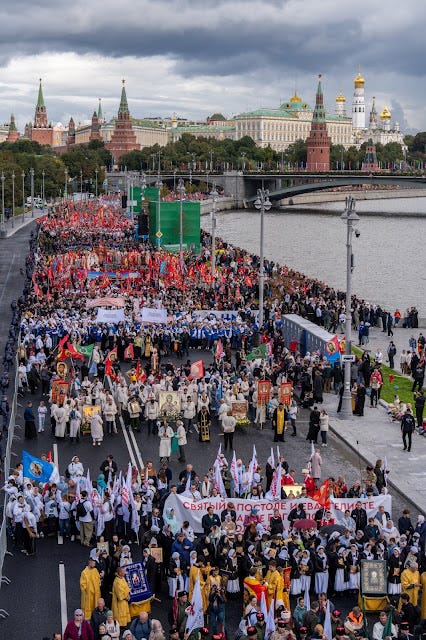
Photo: Press Service of the Patriarch of Moscow and All Rus’
Spyridon will not be alone. On 6 September, a reliquary containing part of the remains of the holy prince Dmitry Donskoy was carried through Moscow in a procession led by Patriarch Kirill. According to the Russian Ministry of Internal Affairs, around 100,000 people took part in the procession, which covered more than six kilometres from the Cathedral of Christ the Saviour to the Novodevichy Convent. From 7 to 20 September, the relic will be available for veneration in the Cathedral of Christ the Saviour, itself originally built to commemorate Russia’s victory in the Patriotic War against Napoleon in 1812.
Donskoy’s remains were uncovered during restoration work in the Archangel Cathedral in the Kremlin in July, and parts of them have been placed in special reliquaries. Some have been promised to Russian units fighting in Ukraine, to provide the soldiers with spiritual support.
During the election weekend, two very different images of Moscow are likely to be broadcast to the world. At the Cathedral of Christ the Saviour, devout Christians will queue to venerate the remains of two saints, while elsewhere Muscovites will go to polling stations to cast their votes in the ballot boxes of a state which, according to Article 1 of its constitution, is a “democratic federal law-governed state with a republican form of government”.
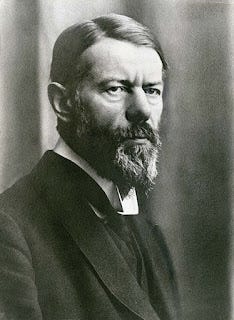
For the sociologist Max Weber (1864–1920), the modern world was characterised by a long process of rationalisation and disenchantment, Entzauberung. Religion and tradition did not disappear, but ever larger areas of social life came to be organised through offices, rules and bureaucracies. According to Weber, the modern state increasingly came to be organised around a legal-rational form of authority.
At first sight, Russia may appear to offer a curious counter-image. At the same time as voters elect the republic’s parliament, a much older and more enchanted past enters the present.
The two saints venerated in the cathedral near the Kremlin during the election nevertheless point in different historical directions. Spyridon, a miracle-working bishop from Cyprus, belongs to the universal history of Christianity and attracts worshippers in expectation of miracles. The holy prince Dmitry Donskoy is remembered above all as the victor at Kulikovo in 1380, a victory that subsequently acquired a central place in the story of Moscow’s gathering of the Russian lands and their liberation from Mongol rule. Donskoy belonged to the Rurik dynasty and thus to the dynastic world whose history reaches back towards ancient Rus’. In Russian media, an explicit parallel has already been drawn between Donskoy and Vladimir Putin. Donskoy is said to have done 650 years ago what Putin is doing today: united the country and its people to free the state from the influence of external powers.
The relics therefore do more than bring religion into the modern state and the modern war. They make history present. Through the story of Donskoy, the war in Ukraine can be situated within a centuries-old history of a Russia said to be gathering itself together, defending its independence and fulfilling a historical mission.
Modern Russia, however, is neither a theocracy nor an empire. In the election of 18–20 September, voters will elect the State Duma’s 450 members. The Russian parliament, the Federal Assembly, consists of two chambers: the Federation Council and the State Duma. According to the constitution, together they constitute the legislative branch. The State Duma participates in the formation of the government and may pass a vote of no confidence in it. Its members hold real offices, and the laws adopted by the Duma are real laws. It is nevertheless difficult to imagine the Duma adopting a politically significant law against Vladimir Putin’s wishes.
Both the members of the Duma and the president are directly elected by the people. The formal distribution of power is clear. The question is how accurately it describes where power actually lies.
That question would also have been intelligible to a Roman living under Augustus. More than two thousand years ago, there was another republic in which the Senate met, consuls were appointed and laws continued to be enacted in republican forms. Caesar Augustus maintained that the republic endured and, indeed, that he had restored it. The old institutions and offices remained. But anyone who wanted to understand how Rome was actually governed needed to know more than the names of its institutions could tell them.
Power and Legitimacy
Why does someone who already possesses power need to persuade others that he has the right to exercise it? Power and legitimacy are not the same thing. A ruler can compel obedience through violence or the threat of violence. But a political order that is to endure can hardly function as though every command had to be enforced at gunpoint. It also needs a conception of why those in power have the right to command and why those who obey should accept their claims to authority.
Max Weber
For Weber, this distinction was fundamental. He distinguished between three ideal types of legitimate authority: traditional, charismatic and legal-rational.
The legitimacy of traditional authority rests on a belief in the sanctity of an established order and in the validity of traditions regarded as having existed since time immemorial. It thus belongs to a world that has not yet fully undergone the rationalisation and disenchantment that Weber associated with modernity. Charismatic authority, by contrast, rests on belief in a leader’s extraordinary personality, heroism or particular calling. Legal-rational authority is based on belief in the validity of impersonal laws and rules, and in the right of officials appointed in accordance with those rules to exercise the powers conferred upon them by their office.
Weber’s three forms are ideal types, not three historical stages that mechanically succeed one another. The modern state can therefore be thoroughly organised through laws, offices and bureaucracies without older forms of legitimation disappearing.
The ballot box and the reliquary in Moscow need not be seen as opposites. They represent two different ways in which a political and social order can be anchored. The election derives its legitimacy from the laws and institutions of the modern republic. The veneration of Spyridon’s 1,700-year-old hand, by contrast, presupposes a world in which the past is not dead and in which the sacred can still act in the present.
The relics of Dmitry Donskoy take this connection between past and present one step further. Here it is not merely a matter of religious veneration. When the remains of the medieval prince are brought to the Cathedral of Christ the Saviour near the Kremlin, and parts of them are promised to Russian units fighting in Ukraine, a historical narrative of Russia is simultaneously activated: of the struggle against external enemies, the gathering of the Russian lands, and of a historical mission extending across the centuries.
The enchanted world and traditional legitimacy are therefore not the same thing. But they can reinforce one another. If the past is still perceived as present and capable of acting in the world, it also becomes possible to derive legitimacy from its sanctity and authority. In the relic, the past is not merely remembered. It becomes present. The new power is legitimised by being presented as the bearer of something far older than itself.
The Restored Republic
Augustus, too, could draw legitimacy from several sources at once. His power had ultimately emerged from the civil wars that followed the assassination of Julius Caesar in 44 BC. Octavian, as he was still known, had armies behind him and eventually defeated Mark Antony and Cleopatra at Actium in 31 BC. When, a few years later, he stood as sole master of the Roman world, it was hardly a lack of military power that prevented him from openly making himself an autocrat.
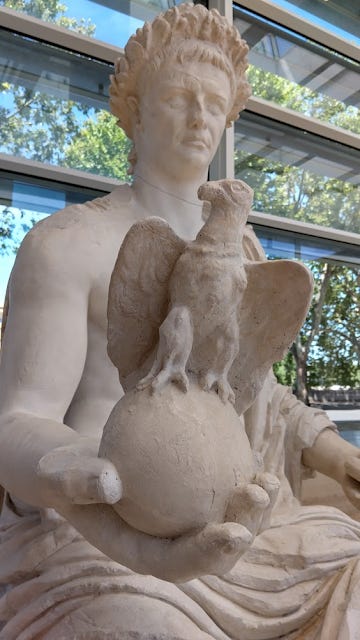
Yet he did not do so. Unlike his adoptive father Julius Caesar, he did not have himself appointed dictator. On the contrary, he presented the extraordinary power that the civil wars had placed in his hands as being returned to the Senate and the Roman people. In 27 BC, Octavian declared that he was handing the state back to the free disposal of the Senate and the people. The Senate responded by bestowing upon him the honorific name Augustus. It is also here that posterity conventionally draws the line between the Roman Republic and the Roman Empire – paradoxically, at the very moment when Augustus claimed that the Republic had been restored.
What followed is generally regarded as the beginning of the Principate. The Republic was not abolished by any solemn decree. The Senate continued to meet. Consuls and other magistrates continued to be appointed. Laws were enacted, and the old offices retained their names. Augustus himself preferred the title princeps, the leading citizen, to any title that would openly have made him a king.
This did not mean that the old Republic had actually been restored. Augustus gradually accumulated a combination of powers that gave him a position no other Roman could match. Augustus himself would later describe the distinction in terms of auctoritas: he surpassed everyone in authority, while maintaining that he possessed no greater formal power than his colleagues.
Augustus controlled the most important provinces and thereby the greater part of the legions. He was granted tribunician power without himself holding the office of tribune of the plebs, as well as a superior imperium – command authority in the Roman sense – which gave him a special position in relation to other commanders and provincial governors. To this were added his immense wealth, his network of clients and supporters, and the personal authority that came from having defeated his rivals and brought decades of civil war to an end.
The formal distribution of power was not fictitious. But it no longer fully described where power lay. Nor was its continued existence irrelevant. The fate of Julius Caesar had demonstrated how dangerous it could be for a Roman ruler to place himself too openly above the Republic. Caesar had allowed himself to be appointed dictator for life and was murdered by men who could, at least in their own eyes, present their deed as a defence of republican liberty. Octavian had built part of his power upon Caesar’s legacy and the name he had acquired through adoption. But he also had reason to learn from his adoptive father’s death.
Augustus’s solution, therefore, was not to replace the Republic with a new constitution that openly established a monarchy. Instead, power was concentrated within an order whose old institutions could still be said to endure. The new power was clothed in the language of the old Republic.
But Augustus was not content with the institutions of the Republic. He, too, made the past present. His rule was marked by a strong emphasis on restoration. Old religious cults and priestly offices acquired renewed importance. Temples were restored. Traditional Roman virtues were extolled. Augustus presented himself not as the founder of an entirely new world, but as the man who, after the disintegration of the civil wars, had restored Rome to its proper order.
This restoration reached further back than the Republic Augustus claimed to have saved. In Virgil’s epic, the Aeneid, Augustus’s age was connected to Rome’s mythical prehistory. Aeneas’s flight from Troy and his arrival in Italy became the beginning of a history that, through his descendants, would lead to Romulus, Rome’s first king, the foundation of Rome and, within the poem’s great historical panorama, Augustus’s own age. The new regime could thus be presented as the fulfilment of a history that had begun long before Augustus was born.
Here there is a similarity with the relics in Moscow that does not require Augustus and Putin to be treated as the same kind of ruler. In both cases, contemporary power can be situated within a much older history. The past provides a language through which the new order can be described as something other than merely new.
For Augustus, this was particularly significant. He had come to power through a civil war that had destroyed the political order he claimed to be restoring. The young Octavian had been a ruthless actor in that struggle. Augustus, by contrast, became the ruler who promised order, peace and continuity. This was not merely a change of name. It was also a way of telling a story about what his power meant.
In Weberian terms, several forms of legitimation can be discerned at once, although it would be anachronistic simply to describe the Roman Republic as a modern legal-rational state. Augustus’s power acquired a legal and institutional form through the offices and powers of the Republic. It was anchored in tradition through religion, ancestral customs and the idea of restoration. And it rested upon Augustus’s own personal authority as Caesar’s heir, the victor in the civil war and the man who had restored peace to Rome.
The legions made Augustus’s power possible. The institutions gave it form. The narratives gave it meaning. Time made it normal.
Augustus ruled for more than forty years after the settlement of 27 BC. Generations of Romans had time to grow up without having experienced the political life of the old Republic, yet with the Senate, the consuls and the republican offices still around them. What had begun as an extraordinary concentration of power became, over time, the normal order.
When Augustus died in AD 14, the system therefore did not disappear with him. Tiberius was able to assume the leading position without anyone having to proclaim a new kingdom or empire. He, too, could rule within republican forms that had now come to sustain a very different distribution of power from that of the old Republic.
This was perhaps Augustus’s most remarkable political achievement. He had come to power as an extraordinary individual in extraordinary times. But he left behind an order that no longer required Augustus himself in order to endure.
The Person and the Office
Here a crucial difference emerges. Augustus had concentrated extraordinary power in his own person, but the order that developed during his long rule eventually became capable of being transferred to someone else. Tiberius could inherit the position Augustus had created without having created it himself. In an institutionalised system of power, authority belongs in principle to the office rather than to the person. Putin’s Russia offers an interesting test of how far this principle holds.
This became particularly clear in 2008. At the time, the Russian constitution did not allow the president to hold office for a third consecutive term. Putin therefore left the presidency. Dmitry Medvedev was elected president and Putin became prime minister.
Formally, the distribution of power was clear. Medvedev was head of state and possessed the extensive constitutional powers of the presidency. Putin headed the government. Yet the change did not mean that the political weight Putin had accumulated during his eight years as president was simply transferred to Medvedev along with the presidential office. A significant part of it seemed instead to follow Putin from one office to another. It was then that it became clear that Vladimir Putin had become something more than the man who happened to hold the office of president.
The fact that this power could follow the person does not mean that the formal institutions were insignificant. But alongside the constitutional distribution of power, another map of power had emerged. Personal loyalties and informal networks played a central role in it, as did control over the security services, state-owned companies and vast economic resources – factors whose importance could not be read from the constitution. Nor were political power and economic wealth entirely separate worlds. Access to great fortunes could depend on one’s relationship with the centre of power, while the loss of political protection could have economic consequences. The powers of the presidency therefore explained much of Putin’s power, but not all of it.
After four years as prime minister, Putin returned to the presidency. Under Medvedev, the presidential term had also been extended from four to six years. In 2020, the constitution was amended again. The restriction was formally tightened from a maximum of two consecutive terms to a maximum of two terms in total. At the same time, a provision was introduced under which Putin’s previous terms would not be counted when the new restriction was applied. He was thus able to stand again in 2024 and, under the present constitution, can do so once more in 2030.
In 2008, Putin adapted himself to the constitution. In 2020, the constitution was adapted to Putin.
When the constitution was amended in 2020, the amendments did not, under the previously existing procedure, have to be submitted to a referendum. The law on the amendments nevertheless made a special nationwide vote a condition for their entry into force. The Constitutional Court itself described the vote as a means of conferring constitutional legitimacy on the decision. The legal procedure had thus been supplemented by a political need for popular endorsement.
For the legal validity of the amendments, it made no difference whether they were approved by a narrow or an overwhelming majority. The official result was 77.92 per cent in favour. The difference between a narrow majority and 77.92 per cent was therefore insignificant for the amendments’ legal effect but significant for the narrative that could be constructed around the result. The former would have meant that the proposal had been approved. The latter could be presented as an overwhelming popular mandate.
Putin’s political dominance did not, therefore, render the legitimating forms of the modern republic meaningless. On the contrary, the constitution and the popular vote gave the continuation of his power a legal and democratic form. Even someone who already possesses power may need a narrative explaining why he has the right to retain it.
A State with Many Pasts
The modern republic, however, is only one of the historical worlds from which Putin’s Russia draws its legitimacy. Anyone walking through the Kremlin encounters a far more variegated history.
There are the cathedrals of the Moscow of the grand princes and tsars. There are the palaces of the Russian Empire and the double-headed eagle that once again became the symbol of the state after the dissolution of the Soviet Union. At the same time, there is Lenin’s Mausoleum by the Kremlin Wall, along with the graves of leaders of the state that overthrew the tsar, persecuted the Church and replaced the double-headed eagle with the hammer and sickle. Above the Kremlin towers, the red stars installed under Stalin still shine.
It is difficult to imagine a more contradictory collection of political symbols. The tsar’s eagle and the Soviet state’s red star once belonged to regimes that denied each other’s legitimacy. The Orthodox Church, which has regained a prominent position in today’s Russia, was persecuted by the very state whose victory in the Great Patriotic War simultaneously constitutes one of the most powerful historical reference points for the Russian state.
Yet these contradictions need not be an obstacle to a legitimating narrative. Historical continuity is not the same thing as ideological consistency. What unites the different eras need not be their ideas about how the state should be governed. It may instead be the idea that, through all the upheavals, there is a historical Russia that endures.
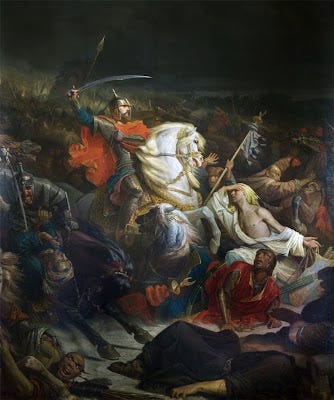
The holy prince Dmitry Donskoy can thus be understood within a wider context. He did not belong to the Russian Empire, still less to the Soviet Union or the modern Russian Federation. He was a prince of the Rurik dynasty in a medieval world that cannot simply be translated into the national states of today. But in the later narrative of Russian history, the victory at Kulikovo has been able to acquire a different significance. Donskoy becomes the prince who gathers the Russian lands around Moscow and leads the resistance against an external power.
With his relics now on display in Moscow, almost seven centuries of constitutional and ideological ruptures need not stand in the way of identification. On the contrary, the distance can be bridged by narrative. The princes of the Rurik dynasty, the tsars, the Russian Empire, the Soviet Union and the modern federation can be placed in different chapters of one and the same long history.
Vladimir Putin himself has repeatedly moved between these historical layers. In his historical narrative, the dissolution of the Soviet Union has appeared as a catastrophic fragmentation of a historical space. The victory over Nazi Germany in 1945 has acquired a central place in the political symbolism of the contemporary state. At the same time, the Orthodox Church has regained a public position that would have been unthinkable during much of the Soviet period. And when Putin has sought to place today’s territorial conflicts within a longer historical perspective, he has been able to reach further back still, to tsars and princes.
He provided a particularly clear example in 2022, when he compared the task facing contemporary Russia with that of Peter the Great. According to Putin, Peter had not conquered territories from Sweden but had taken them back. Now, Putin suggested, it had once again fallen to Russia to take back what had been lost and to strengthen the country.
Here the continuity becomes almost paradoxical. Peter the Great built an empire that the Bolsheviks overthrew. The Bolsheviks created a Soviet state whose dissolution gave rise to the Russian Federation that Putin now leads. According to its constitution, this federation is a democratic republic. Yet its president can simultaneously present himself as the heir to a historical mission that predates both the republic and the Soviet Union.
Legitimating history need not be ideologically consistent in order to create continuity. Donskoy can therefore take his place alongside Peter the Great, the victory over Napoleon in 1812 and the victory over Nazi Germany in 1945. They represent different eras and different political orders, but they can be incorporated into the same grand narrative: Russia is divided or threatened, Russia gathers itself together, Russia defeats the external enemy and regains its rightful place.
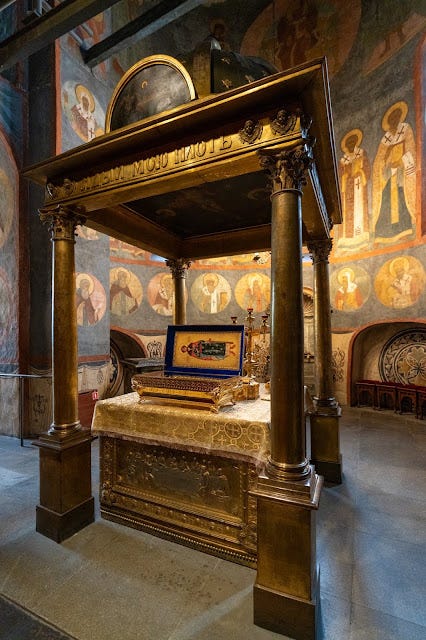
Photo: Press Service of the Patriarch of Moscow and All Rus’
In September 2026, this narrative becomes unusually concrete. While voters go to the polls to elect the parliament of the modern republic, the remains of the medieval prince are only a few kilometres from the place where the republic’s president exercises his power. Some of the relics have meanwhile been promised to soldiers in Ukraine. The distance between Kulikovo and the present war is not bridged by any unbroken institutional tradition. It is bridged by narrative.
This is why the relics in the Cathedral of Christ the Saviour are more than a picturesque encounter between religion and politics. They show how a modern state can live in several historical times at once. The ballot box belongs to the republic. Donskoy belongs to the medieval world of princes. The double-headed eagle evokes the tsardom and the empire. The victory of 1945 belongs to the Soviet Union. Yet all of them can be made part of the story of the same Russia.
When Narrative Meets Reality
A political narrative, however, cannot live on the past alone. It must also be able to give meaning to what is happening in the present. Here lies an important difference between Augustus’s narrative of Rome and the narrative of Russia’s restoration that has come to be associated with Vladimir Putin.
Augustus could present himself as the man who, after decades of civil war, had restored order and peace to Rome. The narrative was legitimating, but it was also supported by the reality in which Romans gradually came to live. The civil wars ended. The new distribution of power stabilised. What had begun as an extraordinary concentration of power could, over time, come to be perceived as the order that had restored peace to Rome.
The narrative of Putin’s Russia, too, has had its moments of confirmation. After the political and economic chaos of the 1990s, Putin could be presented as the leader who restored the state and its capacity to act. The annexation of Crimea in 2014 could be incorporated into the same narrative as the recovery of what was presented as historically Russian land and as a sign that Russia had once again become a great power whose will the outside world had to take seriously.
The full-scale invasion of Ukraine in 2022 posed a much greater test for this narrative. Putin personally claimed ownership of the decision. In his speech on 24 February, he declared that he had made the decision to launch the “special military operation”. At the same time, the war was placed within several of the historical narratives that the Russian state under his rule had made its own: Russia was defending itself against external powers, historically Russian territories were to be reunited with Russia, and the struggle against Nazism in the Great Patriotic War was given a continuation in the present.
It was a narrative with familiar roles. Russia is threatened from outside. The country gathers itself together. The historical leader restores what has been lost. The enemy is defeated and Russia regains its rightful place.
But a narrative of restoration also makes demands upon reality. Sooner or later, it must be able to show what has been restored.
The war in Ukraine has therefore created a problem that is not merely military and economic but also narrative. A war that might have confirmed the image of a restored Russian great power has become protracted. A project justified in terms of the historical unity of Russians and Ukrainians has simultaneously helped to deepen Ukraine’s political and national distance from Russia. And the more clearly the decision to wage war is tied personally to Putin, the more difficult it becomes to separate the outcome of the war entirely from the narrative of Putin as the restorer of Russia.
This does not mean that the narrative has ceased to function. Political narratives are not automatically abandoned because reality contradicts parts of them. They can be reinterpreted. Goals can change, setbacks can be explained, and new enemies can be incorporated into the narrative. A war that began as an attack on Ukraine can be narrated as a defensive war against a much larger Western threat.
Here Dmitry Donskoy acquires a new relevance. The more the present war can be situated within a narrative of a centuries-long struggle against external powers, the less its meaning need be determined by the immediate relationship between Russia and Ukraine. Kulikovo can then become the precursor to yet another version of the same historical struggle, in which Russia is once again said to be fighting for its independence against overwhelmingly powerful external forces.
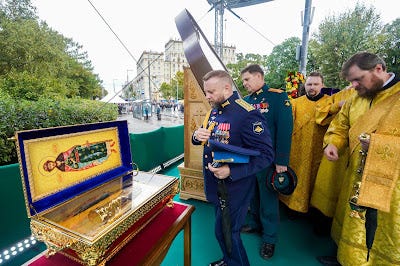
Photo: Press Service of the Patriarch of Moscow and All Rus’
This connection need not be constructed by an outside observer. In connection with the procession in Moscow on 6 September, Russian supporters of the war themselves linked Donskoy’s relics to the idea of a future Russian victory.
It is therefore perhaps no coincidence that Donskoy fits so readily into the contemporary narrative. But there is no need to assume that someone in the Kremlin has orchestrated every symbol in order to recognise its function. The relic gives the contemporary conflict historical depth. It makes it possible to see today’s soldier as a participant in a struggle that began long before he did.
But herein also lies the risk inherent in the narrative. Within it, the adversary can expand from Ukraine into an entire Western system of power. It is more difficult, by the same means, to detach the decision to wage war from the leader who himself claimed ownership of it. Personified success also entails personified responsibility for failure.
Augustus succeeded in creating a system of power that no longer needed Augustus. During Putin’s long rule, the Russian system of power has instead become ever more closely tied to Putin himself. The great question, therefore, is not whether someone can succeed him as president. Someone obviously can. The question is whether anyone can inherit the informal position of power that has grown up around him and, above all, whether the networks and relationships of dependency that Putin has held together can be coordinated around someone else. It remains to be seen whether that order can survive him.
Perhaps it is not only the system of power that faces a problem of succession. The grand narrative may face one as well. A successor can inherit the office of president. It is less obvious that he can also inherit Putin’s place in the narrative of the man who, after the disintegration of the 1990s, restored the state, returned Russia to the ranks of the great powers and took upon himself the task of fulfilling its historical mission. The office can be inherited. It is less certain that the role in the narrative can be.