

The gilded doors stand open as Vladimir Putin enters Alexander Hall in the Grand Kremlin Palace in Moscow. Behind him, in St. Andrew’s Hall, three imperial thrones are visible beneath the double-headed eagle. The president leaves the throne room, but the thrones remain part of the picture.
A president emerges from an imperial room. What history comes through the doorway with him? What message does the setting convey? To understand the scene, we need to follow both the city and the chair far back in time, before Moscow’s claim to be the Third Rome.
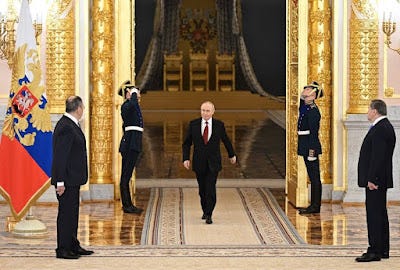
Photo: kremlin.ru
Long before the Kremlin’s thrones, a chair in Rome could make a citizen’s special standing visible. According to the Roman official and historian Suetonius, a golden chair in the Senate was among the honors Julius Caesar accepted. For Suetonius, it signaled that Caesar had accepted distinctions that exceeded the Republic’s traditional bounds. The chair elevated him, while also feeding suspicions that he intended to establish royal rule.
Augustus’s power took a more restrained form. According to the Roman statesman and historian Cassius Dio, Augustus was granted the right to sit on a curule chair—a Roman magistrate’s chair—between the two serving consuls. The Republic’s offices remained, but between their holders sat a man whose power far exceeded theirs. Even a chair within the old order could mark a new supremacy.

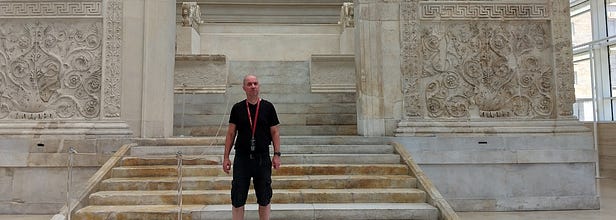
Sella curulis, a Roman magistrate’s chair
Rome also became the seat of another kind of authority. A bishop’s chair, his cathedra, represented his responsibility to teach and lead the Church. The chair also gave the cathedral its name. The Chair of St. Peter came to express the claim of the bishops of Rome to carry on the Apostle Peter’s mission. The Latin Church, however, also adopted elements of the Roman Empire’s language of authority. When Gregory XIII reformed the Julian calendar in Anno Domini 1582, he could also be portrayed as Julius Caesar’s successor in the role of pontifex maximus, Rome’s chief priest.
As emperors moved their courts to other cities, Rome ceased to be the unquestioned center of political power, but its ecclesiastical seat endured. The city and the chair could follow different paths: the emperor’s seat could move, while the bishop of Rome continued to trace his authority to Peter, who, according to the Gospel of Matthew, was the rock on which Jesus would build his Church and had been given the keys of the kingdom of heaven. According to tradition, Peter was the city’s first bishop and, like the Apostle Paul, suffered martyrdom in Rome. In the Lateran Basilica, the bishop of Rome still has a physical chair. The Holy See—the term see itself derives from a word for a seat—denotes the papal office and the Roman Curia. It is based in Vatican City but legally distinct from the Vatican City State.
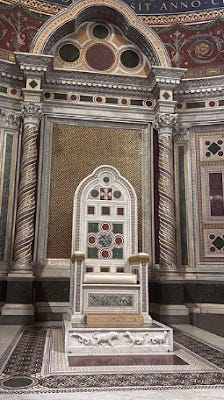
The pope’s chair in the Lateran Basilica
In AD 330, Constantine, the first Christian emperor, dedicated the city on the Bosporus that bore his name. Constantinople became a new imperial center within the Roman Empire. The emperor had not founded an Eastern Roman Empire alongside a Western one: having defeated his rivals, he ruled the entire empire alone. But Rome now had a rival, a city in which Roman power could take a new form.
Constantine had also given Christianity a privileged position. Under his successors, Constantinople became increasingly a center of both imperial power and Christian authority. The city’s political importance received explicit ecclesiastical recognition at the council of 381. The bishop of Constantinople was given second place in the Church’s order of honor, after Rome, because his city was “New Rome.” Here, the city gave the see its rank. In the sixth century, its holder also began to be called the Ecumenical Patriarch, a title whose claims were connected to the world of the empire.
The same Constantine had also commissioned the first St. Peter’s Basilica in Rome, over the site venerated as the apostle Peter’s tomb. The basilica became the sacred heart of the area that would much later become Vatican City. The emperor who gave the new Rome its political prominence thus also helped strengthen the old Rome’s ecclesiastical authority.
Yet the Church of Constantinople also grounded its authority in an account of apostolic origins. According to Church tradition, Andrew, Peter’s brother and the first-called of the apostles, had founded the Christian community in ancient Byzantium and appointed its first bishop. Alongside Peter’s see in Rome stood Andrew’s see in Constantinople. The new imperial city could claim an origin far older than Constantine.
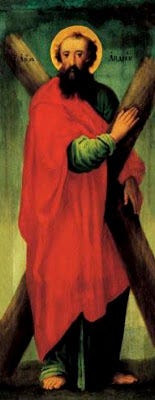
A Ukrainian icon of the Apostle Andrew
Emperor and bishop had distinct responsibilities, but their authority came to be joined in the idea of a Christian Roman Empire. Under Justinian, the Hagia Sophia that still stands today was built in the sixth century. The Church of Holy Wisdom gave monumental form to the meeting of Christian faith and imperial power. The empire we usually call Byzantium understood itself to be Roman.
From this Christian empire, connections extended across the Black Sea to Rus’, the medieval realm whose principal center was Kyiv, traditionally spelled Kiev in English. In the late tenth century, its prince Volodymyr—Vladimir in the Russian form of the name—embraced Christianity and married Anna, the sister of Emperor Basil II. According to tradition, he was baptized at Chersonesus in Crimea. The precise location of his baptism and the sequence of events remain disputed, but the connection with Byzantium was both religious and dynastic.
Kyiv, too, had a place in the stories of Andrew. According to the medieval chronicle tradition, the apostle had visited the hills where the city would later rise, erected a cross, and foretold that many churches would be built there. In this account, sacred history reached back beyond the prince’s conversion to the age of the apostles themselves.
Kyiv became a center of the Christian tradition transmitted from Byzantium. Clergy, art, and models of church life tied the city to Constantinople. Under Volodymyr’s son Yaroslav the Wise, Kyiv’s St. Sophia Cathedral was built, its name and splendor recalling the imperial city on the Bosporus. The inheritance thus acquired a place as well: when Moscow later claimed the history of Rus’, the road back to Byzantium led through Kyiv.
Moscow’s princes belonged to the Rurik dynasty, the same princely house as Volodymyr and Yaroslav. Their ancestry connected them to Kyiv and to the prince whose baptism and Byzantine marriage had linked Rus’ to the Christian empire. As Moscow grew in power, its expansion could be presented as a gathering of the lands of Rus’. The ruler claimed an inheritance extending far beyond his own principality.
The ecclesiastical seat also moved. The Metropolitan of Kyiv and All Rus’ transferred his residence to Vladimir in the late thirteenth century, and his successors subsequently moved to Moscow. The title carried a geography larger than the city in which its holder lived. Moscow became the seat of a religious authority tracing its origins to Kyiv and Constantinople. “All Rus’” joined a memory of origins to a claim of jurisdiction.
In the fifteenth century, the relationship with Constantinople changed. At the Council of Florence in 1439, Byzantine representatives had accepted a church union with Rome, hoping also to secure help against the Ottomans. One of the union’s leading advocates was Isidore, Metropolitan of Kyiv and All Rus’, residing in Moscow. There, the union met resistance. When Isidore returned to Moscow in 1441, Grand Prince Vasily II had him imprisoned for supporting reunion with Rome. The prince thus intervened against the metropolitan appointed by Constantinople and presented himself as a defender of the true faith. In 1448, the bishops in Moscow appointed a metropolitan of their own without Constantinople’s confirmation. Ecclesiastical independence emerged alongside Moscow’s ability to portray other church centers as compromised in matters of faith.
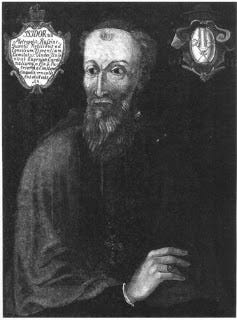
Isidore, Metropolitan of Kyiv and All Rus’
In 1453, Constantinople fell to the Ottomans. The capital of the Christian Roman Empire had been lost, but other rulers could still claim its inheritance. When Ivan III married Sophia Palaiologina, a niece of the last Byzantine emperor, in 1472, Moscow’s princely house gained another dynastic connection with Byzantium. It could give the idea of an inherited imperial legacy both a name and a blood tie.
In the early sixteenth century, the monk Philotheus of Pskov gave this idea its most famous expression: “Two Romes have fallen, the third stands, and there will be no fourth.” In this account, the first Rome had fallen away from the true faith; the second had come under a Muslim ruler. Moscow appeared as the remaining guardian of the true Christian realm. Its ruler’s responsibility therefore extended beyond governing a country. He was to preserve the order that the earlier Roman centers could no longer defend.
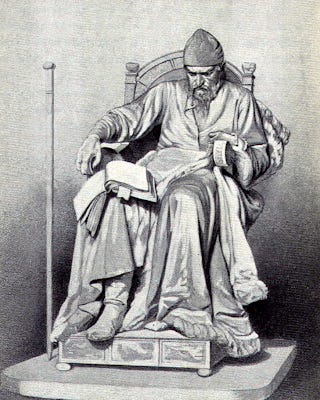
Ivan IV, also known as Ivan the Terrible
In 1547, Ivan IV was crowned tsar, a title whose name derives from Caesar. In 1589, the Patriarch of Constantinople elevated Moscow’s metropolitan, Job, to the rank of patriarch. Moscow now had both a tsar and a patriarch, and “All Rus’” appeared in both their titles. Dynastic descent, ecclesiastical succession, and the duty to defend the true faith could be joined in a narrative in which Moscow carried the inheritance of both Kyiv and Christian Rome. When the Romanov dynasty came to power in 1613, it also inherited the tsar’s dignity and these claims.
Moscow’s position as a political and religious center, however, has not been uninterrupted. Peter the Great built a new capital on the Gulf of Finland and moved the center of power to St. Petersburg. He also left the patriarchal office vacant and in 1721 replaced it with a synod under state supervision. Imperial power could endure even as both the capital and the leadership of the Church were reorganized.
Moscow nevertheless retained its place in the empire’s sacred geography. Emperors continued to be crowned in the Kremlin’s Dormition Cathedral. When the Grand Kremlin Palace was built in the nineteenth century, St. Andrew’s Hall became its throne room. Imperial coronation processions departed from here, and the newly crowned rulers returned here to receive homage. St. Petersburg was the capital, but Moscow remained the place where the emperor’s dignity was confirmed through coronation.
After the monarchy fell, a church council restored the patriarchate in 1917. The following year, the Bolshevik government moved the capital from Petrograd to Moscow. The city once again became the seat of both political power and the patriarch, now under a regime that would soon subject the Church to extensive persecution.
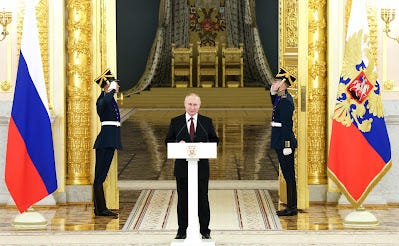
Russia’s president at the lectern in front of the entrance to St. Andrew’s Hall
Photo: kremlin.ru
The imperial rooms did not remain untouched either. In the 1930s, St. Andrew’s and Alexander Halls were converted into a single Soviet assembly hall. Between 1994 and 1998, they were restored by order of President Boris Yeltsin. It was the new republic that restored the splendor of the empire’s rooms. The three thrones recall the last imperial coronation, in 1896: here Nicholas II sat with his wife, Alexandra Feodorovna, and his mother, the Dowager Empress Maria Feodorovna, as they received homage after the coronation. The chair survives in our language of authority as well: power has its seat, a ruler takes the throne, and a bishop holds a see.
In St. Andrew’s Hall, today’s president takes his oath of office. After his inauguration in 2024, Putin also attended a prayer service led by Patriarch Kirill in the Kremlin’s Annunciation Cathedral. This was a different church from the emperors’ coronation cathedral, but once again a state ceremony was followed by an act of worship.
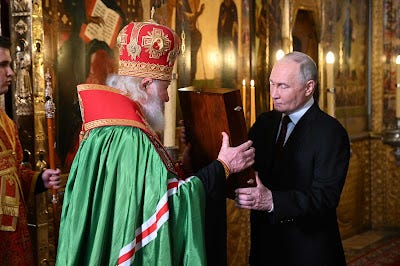
A service of thanksgiving on the occasion of the Russian president’s inauguration
Photo: dev.patriarchia.ru / Press Service of the President of Russia
Putin does not need to sit on an imperial throne to become part of the imperial picture. With the doors held open, the thrones remain visible behind him. Through the room, the ceremonies, and the symbols, power acquires a history reaching further back than the present state. Succession takes visible form, despite the breaks and transformations separating the president’s office from the emperor’s.
But the claim to “All Rus’” also leads back to the city where this Christian inheritance once had its center: Kyiv.
Kyiv is more than a place of origin in Moscow’s narrative. The city also has a church history whose connections with Constantinople and Rome need not pass through Moscow.
In 2018, the Ecumenical Patriarchate in Constantinople decided to proceed with recognizing an independent Ukrainian Orthodox church. In December, the Orthodox Church of Ukraine was established at a unification council in Kyiv. Its principal constituent bodies were the Ukrainian Autocephalous Orthodox Church and the Ukrainian Orthodox Church–Kyiv Patriarchate, whose very names had already asserted ecclesiastical independence from Moscow. In January 2019, Patriarch Bartholomew of Constantinople presented the document confirming the new church’s autocephaly—its ecclesiastical self-government.
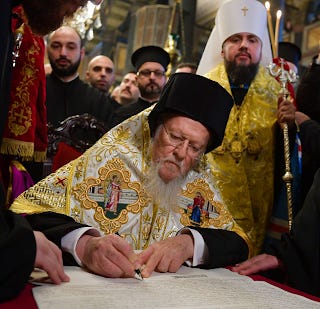
Patriarch Bartholomew signs the document granting autocephaly to the Orthodox Church of Ukraine in Istanbul on January 5, 2019. Metropolitan Epiphanius stands behind him.
Constantinople acted here as the mother church of the Christianity once transmitted to Rus’. Moscow rejected Constantinople’s right to grant a Ukrainian church independence and had already broken Eucharistic communion with the Ecumenical Patriarchate in October 2018. The conflict over ecclesiastical allegiance had thus intensified several years before the full-scale invasion.
In Moscow’s narrative, the Byzantine inheritance was to be gathered under its own see. Constantinople’s recognition of an independent Ukrainian church made the branching of that inheritance visible in the present church order as well. Viewed through this narrative of inheritance, the rupture can also look like Moscow cutting off a branch on which its own claim to authority rests.
The Holy See also has a connection with Kyiv. In 2005, the head of the Ukrainian Greek Catholic Church moved his seat from Lviv to Kyiv. The Church described this as a return to its city of origin. It preserves the worship of the Byzantine rite while remaining in communion with the pope in Rome. It, too, traces its history to Volodymyr’s Christianization of Rus’.
Its relationship with Rome took lasting ecclesiastical form through the Union of Brest in 1596, when part of the Church under the Metropolitan of Kyiv entered communion with the papal see. But encounters between Rus’ and the papacy had begun much earlier. In 1253, Prince Danylo Romanovych, also known as Daniel of Halych, was crowned King of Rus’ by a papal legate. He sought support against the Mongols. He, too, belonged to the Rurik dynasty, but his realm lay in Halych and Volhynia. A kingdom of Rus’ could thus look to Rome for its crown.
The coronation did not establish the later Greek Catholic Church. It does show, however, that even in the Middle Ages, the history of Rus’ contained several political centers and several paths to Christian authority. When Moscow later presented itself as heir to all Rus’, it was claiming to gather an inheritance that had already branched out.
In Kyiv, these connections meet again. Constantinople and Rome do not offer the same kind of recognition or represent the same ecclesiastical order. But both make it possible to carry forward the story of the Christian inheritance of Rus’ without treating Moscow as its only seat.
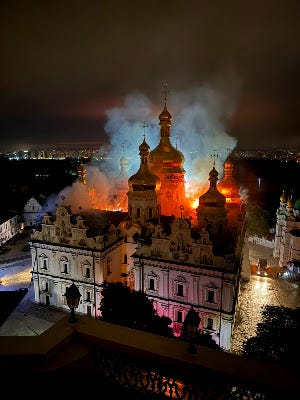
The Dormition Cathedral in the Kyiv Pechersk Lavra in flames, June 15, 2026
Photo: mincult.gov.ua
The war also strikes at the sacred inheritance Moscow claims to defend. During the Russian air attack on Kyiv overnight into June 15, 2026, the Kyiv Pechersk Lavra monastery was damaged, and a fire broke out in its Dormition Cathedral. Moscow’s war thus also threatens the holy places that connect its own church history with Kyiv.
Ukraine does more than contest the Moscow Patriarchate’s claim to “All Rus’.” The Christian inheritance also belongs to the history Ukraine itself invokes as it defends its independence. On July 15, 2026, Ukraine celebrated its Statehood Day and commemorated the Christianization of Rus’, when, according to tradition, Volodymyr had the people of Kyiv baptized in the Dnipro River. Speaking of this baptism, Volodymyr Zelenskyy said: “It happened here, in our city, on these hills of ours, more than a thousand years ago, in the time of our Volodymyr the Great.” He then connected the prince’s trident to Ukraine’s national coat of arms and the insignia worn by the soldiers defending the country. The medieval prince’s emblem expressed a connection between Christian Rus’ and Ukraine today.
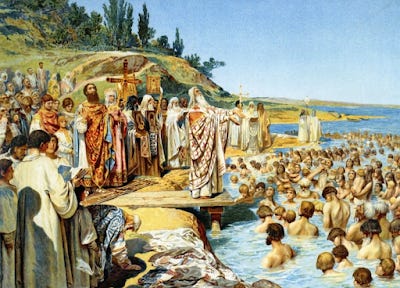
The Baptism in the Dnipro, a painting by Klavdy Lebedev
Tradition places Volodymyr’s personal baptism at Chersonesus in Crimea. But the account of his people’s baptism belongs to Kyiv and to the Dnipro River, which flows through the city. The river thus acquires a biblical geography as well. In the Ukrainian Greek Catholic Church’s catechism, the Dnipro, where the people of Kyiv were baptized, is figuratively called “the Ukrainian Jordan.”
When the president and first lady gathered for prayer in St. Sophia Cathedral on Ukraine’s Independence Day, August 24, 2026, several of these lines of inheritance met beneath the same vaults. Representatives of the Orthodox Church of Ukraine, the Greek Catholic Church, and the Roman Catholic Church prayed alongside Jewish and Muslim representatives, as well as Reformed Christians, Baptists, and Pentecostals. Their prayers were for peace and independence, for the country’s defenders, and for those whom the war had separated from their families.
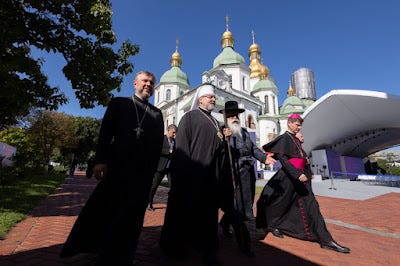
Participants in Ukraine’s Independence Day celebrations at St. Sophia Cathedral, August 24, 2026
Photo: unian.ua
St. Sophia Cathedral’s name connects Kyiv with Constantinople, as do the Christian tradition transmitted from there and the Orthodox Church of Ukraine’s renewed ties to the Ecumenical Patriarchate. Among those praying were also church representatives in communion with Rome. In the city on the Dnipro, the inheritance lives on through more than one ecclesiastical seat. And the history Moscow invokes to claim all Rus’ is also the history Ukraine invokes as it defends itself against the Russian invasion.