


On 12 July 2021, Vladimir Putin published a lengthy historical essay on Russkyi mir, the Russian world, entitled “On the Historical Unity of Russians and Ukrainians”. What was unusual was not only its content. The essay was published simultaneously in Russian, English and Ukrainian. Although one of its central claims is that Russians and Ukrainians historically constitute “one people”, this particular text was, exceptionally, also published in Ukrainian. It was thus made available to three different audiences: Russians, Ukrainians and the wider world. But the narrative did not necessarily serve the same purpose for each of them.
History as a Weapon
Putin’s essay provides an example of how history can be instrumentalised by being shaped into a narrative, which in turn is used as a weapon. In English, this phenomenon has also been described as the weaponisation of history.
Russia’s war against Ukraine has not been fought with soldiers, missiles and drones alone. From the outset, it has also been fought with narratives. According to one of them, expressed particularly clearly in Putin’s essay, Ukraine is historically part of the Russian world, a country whose separation from Russia is the result of historical mistakes and manipulation by foreign powers. According to another, the war is the result of NATO’s eastward expansion: Russia protested for decades, the West refused to listen, and in the end Moscow was forced to act.
The two narratives can be used to legitimise the same war, but they do not quite tell the same story, nor are they necessarily directed at the same audiences. The narrative of the Russian world stretches back centuries and is about history, identity and belonging. The narrative of NATO expansion is shorter and more causal: a series of Western decisions led to a situation in which Russia is said to have been forced to respond. The first tells us above all who Russians and Ukrainians really are. The second explains why Russia must act.
But not all narratives used in information warfare need to be grand narratives about peoples, history and the causes of war. Sometimes they may concern a single explosion, a massacre, an act of sabotage or a drone. And sometimes a narrative does not even need to be credible enough to persuade. It may be enough for it to make the recipient doubt the other narrative.
Narratives can therefore legitimise wars, create identities, explain events and influence how an adversary acts. But when did the narrative become a weapon? By the time the concept of the strategic narrative began to establish itself within strategic studies some two decades ago, narratives had already been used as instruments of warfare for thousands of years.
Narratives in War
In 480 BC, the Greek fleet faced the vast Persian fleet of Xerxes. Ever since Cyrus the Great had conquered Lydia in 546 BC and brought the Greek city-states of Ionia, in what is now western Turkey, under Persian rule, the Persian Empire had posed a growing threat to the Greek world.
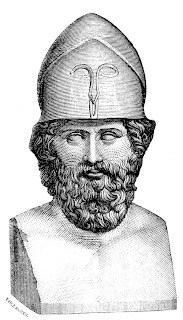
Themistocles
Even before Salamis, Themistocles had sought to influence the Ionian Greeks serving in the Persian fleet. According to Herodotus, the father of history, he had messages carved at watering places along the coast reminding the Ionians that they themselves were Greeks and were now fighting against their own people. Ideally, they would change sides; if that was not possible, they should at least hold back in battle. Herodotus attributes a dual purpose to Themistocles: either the messages would influence the Ionians, or they would reach Xerxes and cause him to begin doubting their loyalty.
At Salamis, Themistocles used a different method. He wanted to induce the Persians to attack in the narrow straits. According to Herodotus, he sent his servant Sicinnus to the Persians with the message that the Greeks were divided, that they intended to flee, and that Themistocles himself was in fact on the Persian king’s side.
Xerxes did not have to be forced into the straits. He acted of his own accord on the basis of the picture of reality he had been given. Two and a half millennia before the Soviet theory of reflexive control, we thus find in Herodotus an account of the same basic mechanism: give your adversary the information that leads him to make, of his own accord, the decision you want him to make.
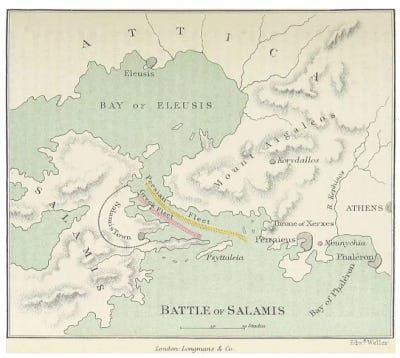
We cannot know how European history would have developed had the Persians prevailed at the Battle of Salamis. But the idea that Salamis saved something greater than the Greek city-states itself became a powerful historical narrative. Alexander the Great was already able to link his own war to the Persian invasions. When Alexander invaded Persia a century and a half later, the war was presented as retribution for Xerxes’ invasion and the Persian desecration of Greek sanctuaries.
Once Alexander had defeated the Persian Great King Darius III and conquered the Persian Empire, the narrative of Greek vengeance was no longer enough. He was no longer merely the Macedonian king leading the Greeks against Persia, but the ruler of the vast empire he had conquered. Alexander therefore also began to present himself as heir to Persian kingship. He adopted elements of Persian court ceremonial, brought Persian nobles into his service, and employed symbols and practices that could legitimise him in the eyes of the empire’s Persian elite. The narrative had changed because the political need had changed: the conqueror now had to appear as the legitimate ruler of those he had defeated.
Narratives could thus be directed both inwards and outwards. Throughout history, narratives of origins, gods, heroes, enemies, sacrifice, victories and defeats have been used to legitimise power, create a sense of community, provide meaning and mobilise one’s own people, but also to influence how an adversary perceives a situation and chooses to act.
The Narrative Turn
With the European Enlightenment came the notion that myth belonged to an earlier stage of human development. Narratives nevertheless lived on. They could be about the birth of the nation, revolution, the emancipation of the proletariat, the progress of civilisation, the communist future, the free world – or liberation from myths. Modern societies that believed themselves to have left myths behind produced some of the most powerful political narratives in history.
Towards the end of the twentieth century, narrative came to be understood as something more than a literary form or a way of recounting events that had already taken place. It orders events temporally and causally. It determines what belongs together, what constitutes a beginning and what follows from it, who is victim and who is perpetrator, and what meaning events acquire. Within the study of history and the humanities more broadly, there was a growing recognition that narratives do not merely represent reality, but also help shape how it becomes intelligible.
In psychology, scholars began to examine how people construct their identities through narratives about their lives. In sociology, attention turned to the importance of narratives in defining a “we” in relation to others. In international politics, researchers similarly began to study how states tell stories about who they are, what the world looks like and what future should be pursued. From this follows an almost self-evident strategic conclusion: whoever can influence the narrative can also influence how others perceive their options for action.
From Narrative to Strategic Narrative
A few decades after the narrative turn in the humanities, narrative also acquired a more prominent place in modern strategic theory. In 2006, the British military historian Lawrence Freedman introduced the concept of the strategic narrative into security and strategic studies. For Freedman, what made a narrative strategic was that it was deliberately constructed or reinforced in order to influence how others responded to events.
A few years later, the concept was taken up by Alister Miskimmon, Ben O’Loughlin and Laura Roselle. In their 2013 book Strategic Narratives: Communication Power and the New World Order, they developed it into a broader analytical framework for international politics. Miskimmon, O’Loughlin and Roselle distinguish between three types of strategic narrative: narratives about the international system, about the identities of actors, and about specific political issues. This classification primarily describes what the narratives are about. But the word strategic also has an older and more specific meaning in military theory. There, a distinction is made between the strategic, operational and tactical levels.
Put simply, strategy concerns how military means are used to achieve overarching political objectives, while tactics concerns how military units and weapons systems are employed in combat. Between these lies the operational level, which concerns how individual battles and operations are combined into larger military campaigns that serve strategic objectives.
The operational level is the youngest of the three. While strategy and tactics have ancient roots, the idea of a distinct operational level was developed above all in Russian and Soviet military thought. During the 1920s, the Russian general, military historian and theorist Alexander Svechin gave operational art a clear theoretical formulation as the link between the individual battles of tactics and the overarching war aims of strategy. Svechin himself put it this way: tactics forms the steps from which operational leaps are built, while strategy points the way.
If warfare can be analysed at the strategic, operational and tactical levels, it seems natural to apply the same distinction to narratives of war. The distinction between strategic, operational and tactical narratives is not as well established in narrative research, but it draws on a long-established distinction in military theory.
Narratives at Three Levels
Russian war narratives surrounding Ukraine operate at all three levels. First, there is the historical identity narrative of Russkyi mir. It is a narrative with limited persuasive power beyond Russia’s borders, but it nevertheless carries a message to the outside world: the West should understand that Ukraine is not simply another foreign country from Russia’s perspective, and that Ukraine’s integration with the West therefore touches upon fundamental Russian interests.
Another strategic narrative is that of NATO expansion: the story of how the post-Cold War international order and the actions of the West gradually created a situation in which Russia was ultimately forced to respond. Here, the state works through speeches, essays, state media and diplomacy, while social media give the narrative international reach and allow it to be retold in countless variations.
At the operational level, we find narratives about red lines and escalation. They are intended to influence Western decisions on arms deliveries, weapons range and restrictions on their use. They do not need to persuade the recipient to accept Russia’s strategic narrative of why the war is being fought. It is enough that they influence how the war is fought: which weapons are supplied, when they are supplied and how they may be used.
At the tactical level, we find narratives surrounding individual events, such as the Bucha massacre, individual attacks, acts of sabotage or drone incidents. Here, several mutually incompatible versions can be used to create uncertainty rather than persuasion. The aim need not be for any one version ultimately to be accepted as true. It may be enough to make it more difficult to establish responsibility, buy time or sow doubt about what actually happened.
When Every Soldier Becomes a Storyteller
The internet and social media did not change the fundamental function of narrative, but they radically changed the conditions under which narratives could be produced and disseminated. Previously, states and large media organisations had largely controlled the channels of distribution. Now the same narrative could be spread through state media, Telegram channels, Facebook, Twitter (X), YouTube and TikTok, retold by thousands of users and adapted to different audiences.
For information warfare, this created new opportunities. A narrative no longer had to be conveyed in a single official version. It could be produced in countless variations, amplified through networks of accounts and given further reach by algorithms that favoured content attracting attention and engagement. During the war in Ukraine, Russian state media and state-linked actors used these opportunities to disseminate and amplify already established narratives.
But the same transformation also meant that the state lost some of its control over information coming from the war. Smartphones turned soldiers and civilians into potential photographers, filmmakers and publishers. Images of military units, destroyed vehicles, dead soldiers and civilian casualties could reach an international audience before passing through any military or political information apparatus. A war could now be documented almost in real time by those in the midst of it.
Algorithms also made dissemination selective. Material that provoked strong reactions could be amplified far beyond its original audience. But by the time the full-scale invasion began in 2022, smartphones and social media had already created an information environment in which an individual soldier or civilian could influence the narrative of an entire war.
The Strategic Corporal
As early as 1999, the American general Charles Krulak had described a related phenomenon with the expression the strategic corporal. According to Krulak, the modern combat environment placed ever greater demands on judgement and independent decision-making far down the chain of command. Junior leaders could find themselves in complex situations without the possibility of waiting for detailed orders from above, and therefore had to understand not only their immediate task but also the broader objectives it served. A decision at the tactical level could thus have consequences at the strategic level.
When Russia launched its full-scale invasion of Ukraine in 2022, the difference between two military command cultures quickly became apparent. The Russian military was characterised by a strongly hierarchical command structure in which initiative and decision-making were concentrated at higher levels. The Ukrainian Armed Forces, by contrast, had in the years since 2014 moved towards a more decentralised system of mission command, in which junior commanders were given greater responsibility for adapting the execution of their missions to conditions on the ground.
At the same time, global news coverage and, later, social media gave the strategic corporal an additional dimension. Individual actions and mistakes on the ground could immediately spread around the world and affect a country’s political legitimacy or the strategic narrative that its armed forces were seeking to maintain. In the social-media environment, it could therefore be enough for the strategic corporal to take out his phone. Russia, however, had a centralised military system operating in a decentralised information environment.
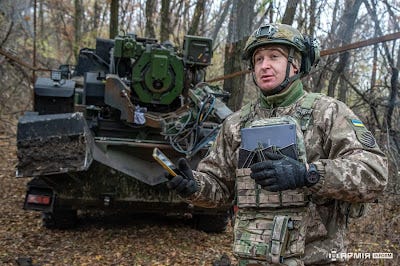
Source: Ministry of Defence of Ukraine, mil.gov.ua, CC BY 4.0.
The difference between the two command cultures became significant from the very first days of the invasion, as Ukrainian units were forced to respond rapidly and locally to an offensive unfolding simultaneously on several fronts. But the difference was not confined to decision-making on the battlefield. Ukrainian soldiers and units quickly demonstrated a considerable ability to make use of the new information environment. Images and videos from the fighting circulated through social media and showed not only that Ukraine was resisting, but that Russian forces could actually be defeated. Material from the tactical level thus became part of Ukraine’s strategic narrative of the war.
But the flow of information did not consist solely of material deliberately disseminated by Ukrainian soldiers and authorities. The war was also documented by civilians and journalists, while commercial satellite imagery and other open sources made it possible to verify and supplement material from the ground. When Russian forces withdrew from Bucha outside the Ukrainian capital in the spring of 2022, images and videos of bodies lying in the streets quickly spread through social media. The Russian information apparatus responded with several partly contradictory narratives: the Ukrainians had killed the victims; the bodies had been placed there after the Russian withdrawal; the footage had been staged, and so on.
Material from mobile phones could be compared with commercial satellite imagery. Maxar satellite images taken while Russian forces still controlled Bucha showed objects resembling bodies in the same locations where the bodies were later documented from the ground. In addition, a local Telegram channel had published footage of the bodies as early as 1 April. This made the Russian claim that the bodies had been placed there after the withdrawal very difficult to sustain.
The Narrative Meets Reality
A central premise of the Russkyi mir narrative was the idea of Ukraine as a country whose natural historical and cultural connection with Russia had been severed by nationalism and Western influence. During the first days and weeks of the invasion, however, videos circulated of Ukrainians standing in front of Russian armoured vehicles, berating Russian soldiers and demonstrating against the occupation. In Russian-occupied Kherson, civilians took to the streets with Ukrainian flags and openly demonstrated against the soldiers who, according to the Russian narrative, had come to liberate them.
Within the first few weeks, social media were already filled with photographs and videos of abandoned or destroyed Russian vehicles, long stationary columns, captured soldiers and military equipment seized by the Ukrainians. Open-source material from Telegram channels also included images of identifiable unit insignia, equipment and even documents, making it possible to identify Russian units and reconstruct aspects of their activities and movements.
The Russian invasion had been presented as a limited “special military operation” conducted by the armed forces of a modern great power. Digital images from the battlefield quickly began to undermine this image. The world saw abandoned vehicles and logistical chaos, captured soldiers, looting and, before long, documented abuses against civilians.
The Russian model relied heavily on the production and distribution of narratives, but the new information environment had also created a decentralised production of evidence. Social media had turned every soldier and civilian into a potential storyteller, but at the same time into a potential producer of evidence capable of corroborating or disproving the narratives of others.
As a result, the distance between the tactical, operational and strategic levels also began to shrink. Within hours, an image of a single event on the battlefield could acquire significance for the narrative of the entire war.
This phenomenon has been described as strategic compression. The distance between an action at the tactical level and its consequences at the strategic level has diminished. The military chain of command may still be hierarchical, but information does not have to follow the same path. An image from the battlefield can reach a global audience before senior commanders even know that it exists. A tactical event can thus affect an operational narrative and, ultimately, the narrative of the war as a whole.
This makes it more difficult to sustain a strategic narrative when developments on the ground contradict it. Individual images rarely prove anything about an entire war, and they too can be selected, cropped and incorporated into narratives that give them different meanings. But when thousands of images, videos, testimonies and other digital traces point in the same direction over an extended period, the gap between the narrative and observable reality becomes increasingly difficult to sustain.
Russia could call the invasion a limited “special military operation”, describe Ukraine as part of the Russian world and portray the war as a necessary response to NATO expansion. But narratives could not capture Kyiv, hold Hostomel Airport or make the Ukrainians of Kherson welcome Russian soldiers as liberators. In the end, the strategic narrative itself was confronted with a strategic failure.